Monday, June 13, 2011
Staying in Touch
I'd love to get mail. Always a nice surprise to get something in port. Addresses and timelines for sending letters is on the page below. If you send me your address (via my email address) I may just surprise you with a postcard. Hope to get some correspondence.


Sunday, June 12, 2011
Packing Insanity
Well, I managed to pass my dissertation proposal on Friday morning. Begged the doctor for a prescription to help with my epic case of poison ivy, and have been running around town trying to get my crap together before I head to the airport at 0400 tomorrow. (I'm back to using nautical time). I know I'm not mentally prepared for this journey yet b/c I haven't had a chance to take a breath. I guess that's what Tuesday will be for. A day of rest, reflection, and relaxation before I jump into SAS yet again.

Time to get back to sorting through all my stuff and deciding what to bring, what not to bring, and all the little things I know I'm forgetting. (like my camera, which I just remembered. Phew!). Bye Austin. See you in September!
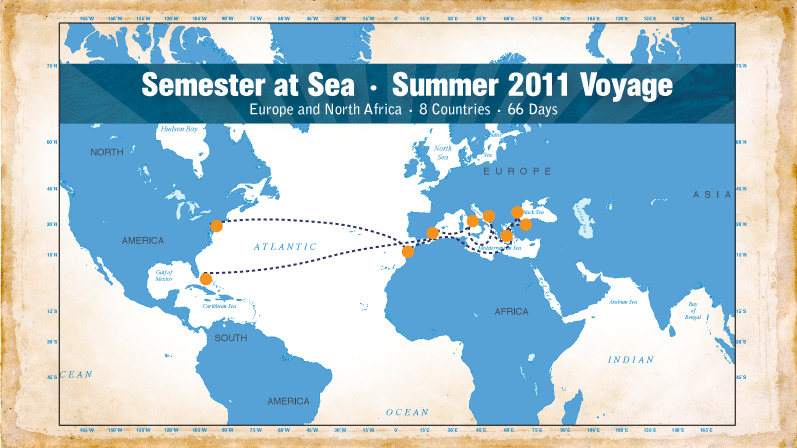
P.S. For those of you whop want to follow my travels. Check out the map below of where I'll be sailing.


Time to get back to sorting through all my stuff and deciding what to bring, what not to bring, and all the little things I know I'm forgetting. (like my camera, which I just remembered. Phew!). Bye Austin. See you in September!
P.S. For those of you whop want to follow my travels. Check out the map below of where I'll be sailing.
Monday, June 6, 2011
One week away!!
In one short week I will be flying out to Nassau, Bahamas for my one day of relaxation before boarding the MV Explorer one again for another adventure. Having spent the last three months getting to know my fellow Student Life Team members via Facebook, I'm excited to meet everyone and get rolling on the high seas.
Before I board the plane, I have a few tiny hurdles. First, my dissertation proposal meeting on Friday has my stomach in knots. I also have to get some paperwork finished for my campus job, and get most of my IRB application finished for my dissertation study. Oh yea... and somewhere in the midst of all this, I need to think about packing too. Phew!
Before I board the plane, I have a few tiny hurdles. First, my dissertation proposal meeting on Friday has my stomach in knots. I also have to get some paperwork finished for my campus job, and get most of my IRB application finished for my dissertation study. Oh yea... and somewhere in the midst of all this, I need to think about packing too. Phew!
Sunday, May 13, 2007
Japan to San Diego Happenings
Well, we’re less than 10 hours out of San Diego. In fact, we’re back in the same time zone as California and Arizona. After traveling around the world, THAT’s hard to believe. I’m not too excited about that, but I am trying to keep a stiff upper lip. But before I get all sappy and reflective (too late) I am going to do an entry updating on all the big ship activities since we left Japan.
The first big event was the Day of Silence. My Diversity Programming Committee led this shipwide event. It was related to Days of Silence that are held on campuses across the country, but we broadened the definition. Normally, the event is held in solidarity with the LGBT community in order to shed light on those whose voices are silenced because they cannot be open about their sexuality. However, we changed things and asked people to be socially silent in respect to the people we have seen around the world whose voices have been silenced by political and social oppression. We specifically referenced people of color in Brazil and South Africa, Women in India and other Ssian nations, and religious minorities and LGBT people in various nations all over the world. When I proposed toe idea, there were many people, especially faculty, who did not think that it was a good idea to have a program that prohibited people from talking or engaging socially. A few of them feared this would be another divisive program like the Apartheid Day Simulation, even though I discussed with many people that this was about reflection, and not division. I tried a different tactic and recruited faculty input, asked them to participate, suggested ways they could discuss it in their classes… etc. Ultimately, the program was a success. We had hundreds of people take information, and at least 300 people took the badges to wear on the day itself, though many fewer were actually silent for the day. I think it was a visible success since many of the more public people in our community took part. So while many people chose not to participate, they still felt the impact of the silence of their peers. Go team!
Next was the Ambassador’s Ball. For those of you who don’t know, this is sort of like our end of voyage Prom, only the money goes to charity. The whole ship gets decked out in their new suits and dresses from Vietnam, or haute couture from Japan (for those who could afford it – not me). They meal served is exquisite and very gourmet, there are lavish decorations, and photographs everywhere, and amazing desserts served on the 7th deck. We also had live music, and a champagne toast at midnight. It was a heavenly evening. I was especially glad b/c there were a group of three tables right near each other with all my staff friends and RD colleagues. So we had a grand old time, and got to enjoy a little pre partying and post partying without students in the staff area of the ship. I do so love being able to escape and have some “adult” time. Part of the fun of the ball, is that I felt like a bit of a celebrity. The students kept asking to take pictures with me, and with some of the other RD’s and staff members, like Dia the Registrar. I think people are trying to get a record of as many people as they can before the voyage comes to an end. I was always willing to pose and flash my pearly whites. I made corsages out of paper for each of the women on the Student Life Team. Mrs. Rigoli would be so proud that I remembered how to do it some 20 years after being in her elementary school Spanish class.
The next big event was a series that the LGBT group on the ship facilitated. We had “Sea The Pride!” LGB Days at Sea. It was a three day series on the days around Honolulu where we worked to educate the community on issues that face LGBT people, and gave folks tips on how to be effective allies. My LGBTA group is full of well meaning, and enthusiastic people, but they are also big idea people and not always big follow through folks. A couple days before the series was supposed to start, they wanted to scrap major sections of it. In the end, all the elements remained and were incredibly successful. It was a real testament to our community and made the LBG folks on board very proud. The first day had a Gender Bender theme, and folks were invited to play with gender stereotypes with their dress. We even had a gender bender theme with the AFTer Hours alcohol service and a number of people attended in drag. It got quite a laugh. At the same time we had tables near the dining rooms where folks were invited to take and wear rainbow ribbons to identify themselves as allies, and to fill out colorful cards giving their definitions of love. Finally, on that first day, we had a “Speak Out” panel with out gays and lesbians from the student body, staff, and faculty, and allies and family members answering questions and sharing their lives with the community. I was really glad to be a part of that panel, and got a lot of great feedback about what I said and how it affected people. The LGBTA folks were so pleased with the panel b/c when it started there were only about 6 or so people in the Union to participate, but after about 15 minutes we had about 40 people present, and by the time 30 minutes had gone by, there were a good 100+ people in the audience really listening. I was so proud of them, and it made them all feel really supported. The second day of the series had a Same-Sex Hand Holding theme. We invited folks on board to display affection with people of the same sex, be they friends, family members, or loved ones. Not many people engaged in this activity, however some of the faculty members did, and it definitely had the community talking. We continued with the table programs, and finished the evening with a big Drag Show Blowout in the evening directly after the Cultural and Logistical Pre-Port for Hawaii. Everyone was worried about this event, b/c as dinner started 2 hours earlier we had only 1 act for the show. However, everything just came together, and the show was a HUGE success. I’ve heard that on past voyages, men in drag is a big theme running through out the voyage. The Sea Olympics, AFTer Hours events, Talent Shows. Supposedly, these are all events that normally have the men n board dressing in drag, for fun, on a regular basis. But that was not the case with our voyage. We hadn’t seen that kind of fun gender bending in our community before our event, and that worried us about the prospects of finding acts outside of the LGB people planning the event. In the end, we had plenty of acts to fill a 2 hour performance. I don’t think the Union has ever been as packed before, and what’s more, everyone was SO into the show. They cheered on their friends and sang along, or got up and danced in the aisles. The acts were a great collection of gay and lesbian students, straight allies (including some of our most eligible male bachelor students). We even had one of our faculty member’s go in drag with her entire family, husband and two daughters included. Dan Cristie, our Global Studies Professor, was in drag for the show… it was a remarkable event. I was particularly pleased with our two student emcees. I wasn’t very excited about the prospect of hosting, and I didn’t really want to “do” drag. I ended up going about half way and wore a sarong and a flower in my hair (as an homage to Hawaii) but that was it. Prof. Biana Cody Murphy and I set up the show and then passed it off to the emcees. Bianca did a great job framing the show and explaining to everyone present that drag is not about gay men seeing themselves as women, or lesbians seeing themselves as men. It’s really about playing with gender stereotypes. We mess with social norms every day as a function of loving people of the same sex, so this is a way to do it in a tongue-in-cheek kind of way. It was great to be able to point to our straight allies in the show as examples of that very fact. The highlight of the entire show was one of our work study students, Roberto. Roberto is a great dancer, who joins us from Puerto Rico. He did a number dressed as Chakira, and he was the prettiest man anyone has seen in a while, and when he started to dance and move his hips, the crowd went wild. He was an amazing (and provocative) dancer. His girlfriend, Mary, was also in drag and dressed like the rapper who sings on the track. The two of them did this whole routine that ended in a very passionate kiss. I gotta tell you, after seeing a handful of drag shows in my day, this number would have put them all to shame. The Drag Show turned out to be such a huge success, and so big in the scheme of the voyage, that when we had our end of voyage slide show, it was given its own category and a fair amount of coverage. The final day of the series had an Ally Development theme, and saw more tabling. We took all the “definitions of love” and posted them in Purser’s Square in a giant rainbow under the banner “Love is not just 1 man + 1 woman – What’s Your Definition of Love?” It was pretty powerful, and a lot of people spent time looking it over. We ended the whole series with a showing of the movie The Laramie Project with a discussion following. Every event was well attended by people who were involved and invested. I have to admit, I didn’t think the entire community would get behind the events, but they did. I was so proud of the folks in the LGBTA @ Sea. Many of them come from campuses that are religiously affiliated and they are the only out people on campus, or from places that are just so conservative that they are not able to find a community. Finding one on Semester at Sea has helped many of them feel more confident about themselves. The opposite was often true for our People of Color, who mainly came from campuses where there were significantly larger populations of people of color. I’m still proud of the community that they built here on the MV Explorer. Can you tell that I am feeling reflective? Geez… I’m such a sap.
I volunteered to facilitate a day in honor of those who died in the tragedy at Virginia Tech, which was held after we left Hawaii. We asked people to wear orange or maroon, Va Tech’s school colors, or black and I posted the names of the victims in Purser’s Square. I regularly saw people stopping and staring at the long list of names… it was a solemn day indeed.
As we moved towards the end of the voyage we’ve has a long string of happy events as well. We held a final Pre-Port meeting where we discussed disembarkation in San Diego. My friend RD Mindy and I created a humorous presentation orienting everyone to the U.S. (“or as we call it in our homeland ‘A-MER-i-ca’”). We taught them how to use regular western toilets, what food they should try out, and what etiquette they should use to fit in (none at all!). The funniest part was teaching them common phrases we use in A-MER-i-ca. We had Ron, “the Voice” saying the phrases for them to learn. The man is SO deadpan, and got this intense expression on his face as he said expressions like “fo shizzle,” and “I’m down with that,” and my favorite “peace out, my brother.” People were crying they were laughing so hard, but Ron never cracked a smile. It was perfect. The strangest part for all of us was when we did a “Pop Culture Catch-Up” where RDs Stephanie Sue and Lesley let us know about what has been happening back in the US while we’ve been gone. The weirdest parts were hearing the top movies and songs right now, especially since none of us have heard of any of them. Disturbia? Fracture? These are movies? Sheesh!
Tonight was the last event of the voyage, Convocation. The staff and faculty led the graduates into the Union. They all wore conical rice hats from Vietnam and looked quite proud of themselves (as they should be). We toasted our accomplishments, and our graduates. We laughed at our collective foibles. We mused over how far we’ve traveled, and how much we’ve grown. I reaffirmed that I am an emotional sap as I was on the verge of tears almost the entire time, but I did manage to avoid a full on cry. It’s scary to realize that this voyage really is almost done. I spent 200 days applying, and interviewing, and anticipating this voyage. I spent 100 days enjoying, and participating on the voyage. What comes next? What happens after 300 days of focus? I wish I had an answer to that question. I know it will all be weighing heavily on my mind as I bid my residents a farewell when they step off the gangway tomorrow morning. Since they won the Sea Olympics, they have the honor of disembarking first. I’m not ready for them to go… hell, I’M not ready to go. But nonetheless, we will leave tomorrow.
Like I said at the start, I’ll save my reflections for later. Right now, the students are downstairs in the Union having their last dance. I doubt any of them will sleep tonight. The faculty and staff are here in the F/S Lounge sharing all open bottles of beverage and open packages of food we can’t off load, enjoying one another’s company. I doubt any of us will sleep tonight either. But for now, I’m going to enjoy my last few hours, and make start processing when I am home in my Irvine bed tomorrow.
Until then,
XOXO
-Drew
The first big event was the Day of Silence. My Diversity Programming Committee led this shipwide event. It was related to Days of Silence that are held on campuses across the country, but we broadened the definition. Normally, the event is held in solidarity with the LGBT community in order to shed light on those whose voices are silenced because they cannot be open about their sexuality. However, we changed things and asked people to be socially silent in respect to the people we have seen around the world whose voices have been silenced by political and social oppression. We specifically referenced people of color in Brazil and South Africa, Women in India and other Ssian nations, and religious minorities and LGBT people in various nations all over the world. When I proposed toe idea, there were many people, especially faculty, who did not think that it was a good idea to have a program that prohibited people from talking or engaging socially. A few of them feared this would be another divisive program like the Apartheid Day Simulation, even though I discussed with many people that this was about reflection, and not division. I tried a different tactic and recruited faculty input, asked them to participate, suggested ways they could discuss it in their classes… etc. Ultimately, the program was a success. We had hundreds of people take information, and at least 300 people took the badges to wear on the day itself, though many fewer were actually silent for the day. I think it was a visible success since many of the more public people in our community took part. So while many people chose not to participate, they still felt the impact of the silence of their peers. Go team!
Next was the Ambassador’s Ball. For those of you who don’t know, this is sort of like our end of voyage Prom, only the money goes to charity. The whole ship gets decked out in their new suits and dresses from Vietnam, or haute couture from Japan (for those who could afford it – not me). They meal served is exquisite and very gourmet, there are lavish decorations, and photographs everywhere, and amazing desserts served on the 7th deck. We also had live music, and a champagne toast at midnight. It was a heavenly evening. I was especially glad b/c there were a group of three tables right near each other with all my staff friends and RD colleagues. So we had a grand old time, and got to enjoy a little pre partying and post partying without students in the staff area of the ship. I do so love being able to escape and have some “adult” time. Part of the fun of the ball, is that I felt like a bit of a celebrity. The students kept asking to take pictures with me, and with some of the other RD’s and staff members, like Dia the Registrar. I think people are trying to get a record of as many people as they can before the voyage comes to an end. I was always willing to pose and flash my pearly whites. I made corsages out of paper for each of the women on the Student Life Team. Mrs. Rigoli would be so proud that I remembered how to do it some 20 years after being in her elementary school Spanish class.
The next big event was a series that the LGBT group on the ship facilitated. We had “Sea The Pride!” LGB Days at Sea. It was a three day series on the days around Honolulu where we worked to educate the community on issues that face LGBT people, and gave folks tips on how to be effective allies. My LGBTA group is full of well meaning, and enthusiastic people, but they are also big idea people and not always big follow through folks. A couple days before the series was supposed to start, they wanted to scrap major sections of it. In the end, all the elements remained and were incredibly successful. It was a real testament to our community and made the LBG folks on board very proud. The first day had a Gender Bender theme, and folks were invited to play with gender stereotypes with their dress. We even had a gender bender theme with the AFTer Hours alcohol service and a number of people attended in drag. It got quite a laugh. At the same time we had tables near the dining rooms where folks were invited to take and wear rainbow ribbons to identify themselves as allies, and to fill out colorful cards giving their definitions of love. Finally, on that first day, we had a “Speak Out” panel with out gays and lesbians from the student body, staff, and faculty, and allies and family members answering questions and sharing their lives with the community. I was really glad to be a part of that panel, and got a lot of great feedback about what I said and how it affected people. The LGBTA folks were so pleased with the panel b/c when it started there were only about 6 or so people in the Union to participate, but after about 15 minutes we had about 40 people present, and by the time 30 minutes had gone by, there were a good 100+ people in the audience really listening. I was so proud of them, and it made them all feel really supported. The second day of the series had a Same-Sex Hand Holding theme. We invited folks on board to display affection with people of the same sex, be they friends, family members, or loved ones. Not many people engaged in this activity, however some of the faculty members did, and it definitely had the community talking. We continued with the table programs, and finished the evening with a big Drag Show Blowout in the evening directly after the Cultural and Logistical Pre-Port for Hawaii. Everyone was worried about this event, b/c as dinner started 2 hours earlier we had only 1 act for the show. However, everything just came together, and the show was a HUGE success. I’ve heard that on past voyages, men in drag is a big theme running through out the voyage. The Sea Olympics, AFTer Hours events, Talent Shows. Supposedly, these are all events that normally have the men n board dressing in drag, for fun, on a regular basis. But that was not the case with our voyage. We hadn’t seen that kind of fun gender bending in our community before our event, and that worried us about the prospects of finding acts outside of the LGB people planning the event. In the end, we had plenty of acts to fill a 2 hour performance. I don’t think the Union has ever been as packed before, and what’s more, everyone was SO into the show. They cheered on their friends and sang along, or got up and danced in the aisles. The acts were a great collection of gay and lesbian students, straight allies (including some of our most eligible male bachelor students). We even had one of our faculty member’s go in drag with her entire family, husband and two daughters included. Dan Cristie, our Global Studies Professor, was in drag for the show… it was a remarkable event. I was particularly pleased with our two student emcees. I wasn’t very excited about the prospect of hosting, and I didn’t really want to “do” drag. I ended up going about half way and wore a sarong and a flower in my hair (as an homage to Hawaii) but that was it. Prof. Biana Cody Murphy and I set up the show and then passed it off to the emcees. Bianca did a great job framing the show and explaining to everyone present that drag is not about gay men seeing themselves as women, or lesbians seeing themselves as men. It’s really about playing with gender stereotypes. We mess with social norms every day as a function of loving people of the same sex, so this is a way to do it in a tongue-in-cheek kind of way. It was great to be able to point to our straight allies in the show as examples of that very fact. The highlight of the entire show was one of our work study students, Roberto. Roberto is a great dancer, who joins us from Puerto Rico. He did a number dressed as Chakira, and he was the prettiest man anyone has seen in a while, and when he started to dance and move his hips, the crowd went wild. He was an amazing (and provocative) dancer. His girlfriend, Mary, was also in drag and dressed like the rapper who sings on the track. The two of them did this whole routine that ended in a very passionate kiss. I gotta tell you, after seeing a handful of drag shows in my day, this number would have put them all to shame. The Drag Show turned out to be such a huge success, and so big in the scheme of the voyage, that when we had our end of voyage slide show, it was given its own category and a fair amount of coverage. The final day of the series had an Ally Development theme, and saw more tabling. We took all the “definitions of love” and posted them in Purser’s Square in a giant rainbow under the banner “Love is not just 1 man + 1 woman – What’s Your Definition of Love?” It was pretty powerful, and a lot of people spent time looking it over. We ended the whole series with a showing of the movie The Laramie Project with a discussion following. Every event was well attended by people who were involved and invested. I have to admit, I didn’t think the entire community would get behind the events, but they did. I was so proud of the folks in the LGBTA @ Sea. Many of them come from campuses that are religiously affiliated and they are the only out people on campus, or from places that are just so conservative that they are not able to find a community. Finding one on Semester at Sea has helped many of them feel more confident about themselves. The opposite was often true for our People of Color, who mainly came from campuses where there were significantly larger populations of people of color. I’m still proud of the community that they built here on the MV Explorer. Can you tell that I am feeling reflective? Geez… I’m such a sap.
I volunteered to facilitate a day in honor of those who died in the tragedy at Virginia Tech, which was held after we left Hawaii. We asked people to wear orange or maroon, Va Tech’s school colors, or black and I posted the names of the victims in Purser’s Square. I regularly saw people stopping and staring at the long list of names… it was a solemn day indeed.
As we moved towards the end of the voyage we’ve has a long string of happy events as well. We held a final Pre-Port meeting where we discussed disembarkation in San Diego. My friend RD Mindy and I created a humorous presentation orienting everyone to the U.S. (“or as we call it in our homeland ‘A-MER-i-ca’”). We taught them how to use regular western toilets, what food they should try out, and what etiquette they should use to fit in (none at all!). The funniest part was teaching them common phrases we use in A-MER-i-ca. We had Ron, “the Voice” saying the phrases for them to learn. The man is SO deadpan, and got this intense expression on his face as he said expressions like “fo shizzle,” and “I’m down with that,” and my favorite “peace out, my brother.” People were crying they were laughing so hard, but Ron never cracked a smile. It was perfect. The strangest part for all of us was when we did a “Pop Culture Catch-Up” where RDs Stephanie Sue and Lesley let us know about what has been happening back in the US while we’ve been gone. The weirdest parts were hearing the top movies and songs right now, especially since none of us have heard of any of them. Disturbia? Fracture? These are movies? Sheesh!
Tonight was the last event of the voyage, Convocation. The staff and faculty led the graduates into the Union. They all wore conical rice hats from Vietnam and looked quite proud of themselves (as they should be). We toasted our accomplishments, and our graduates. We laughed at our collective foibles. We mused over how far we’ve traveled, and how much we’ve grown. I reaffirmed that I am an emotional sap as I was on the verge of tears almost the entire time, but I did manage to avoid a full on cry. It’s scary to realize that this voyage really is almost done. I spent 200 days applying, and interviewing, and anticipating this voyage. I spent 100 days enjoying, and participating on the voyage. What comes next? What happens after 300 days of focus? I wish I had an answer to that question. I know it will all be weighing heavily on my mind as I bid my residents a farewell when they step off the gangway tomorrow morning. Since they won the Sea Olympics, they have the honor of disembarking first. I’m not ready for them to go… hell, I’M not ready to go. But nonetheless, we will leave tomorrow.
Like I said at the start, I’ll save my reflections for later. Right now, the students are downstairs in the Union having their last dance. I doubt any of them will sleep tonight. The faculty and staff are here in the F/S Lounge sharing all open bottles of beverage and open packages of food we can’t off load, enjoying one another’s company. I doubt any of us will sleep tonight either. But for now, I’m going to enjoy my last few hours, and make start processing when I am home in my Irvine bed tomorrow.
Until then,
XOXO
-Drew
Wednesday, May 9, 2007
Aloha Hawaii
Welcome to the islands of aloha! After 8 days at sea, land was a very welcome sight. It was also nice to be able to turn on my cell phone and have it find a signal and dial up the family. It almost seems unfair that we only got 14 hours off the ship to enjoy a place that people try so hard to visit for weeks at a time. But, we all made the most of it. Everyone was itching to get off the ship as quickly as possible, and the different student seas were vying for the privilege to be the first off the ship once we cleared immigration. The contest centered around which sea could sign up the most people to join “The Shipmate Program,” the alumni organization for Semester at Sea. True to form, the Aegean Sea was very competitive, and came in 3rd when 93% of our group signed up. Turtle Power. This meant that my kiddos were off the ship by about 8:30am, and had plenty of time to enjoy the island. Me and the other staff folks all agreed we would go off with the Faculty/Staff Team in whatever order they finished. Little did we know that the F/S group would finish dead last. Ugh! Luckily we were still off the ship by about 9:45am
I’ve heard so many nice things about Hawaii from all the folks at UCI who come from HI, and from my RD friend, Lesley, who lives on Oahu and gushes about her home state whenever the opportunity arises. Our Logistical and Cultural Pre-Ports also got me really excited with conversations about the Polynesian influence, the cuisine, the traditions, the language. I was psyched for my 14 hours in paradise. During our pre-port a group of the women on the ship presented a traditional hula dance, and a group of men learned a Haka dance and performed that as well. The Haka is actually a tradition from New Zealand and the islands of the South Pacific, but was an interesting Polynesian cultural tradition to see. Our Kiwi Professor, Simon Nicholson, taught the guys the dance. Very cool indeed.
 One of the coolest things about our time in Hawaii was that a big group of 15 of us were all going to travel around the island with Lesley and her fiancé Matt. They had planned a whole Oahu itinerary that was special and chock full of fun times. Lesley has been missing Matt a LOT during the voyage. I think she started a countdown to Hawaii when we got to South Africa! It was so cute to see them together. We began our island adventure by driving out of Honolulu to the windward side of the island where the two of them live. On the way over the mountains, we stopped at a popular look out and saw some amazing views, and learned about the battle that took place there when King Kamehameha united the island chain and became the first king of the Hawaiian islands. We then went to Lesley’s hometown of Kailua and stopped at the bank and then her favorite coffee shop, Morning Brew. After we all got our lunch/coffee fixes we headed out to the beach where we got in tandem kayaks and rowed out to the Mokulua Islands. The Moks are only a bit off shore, maybe 20 minutes of hard kayaking. The water was crystal clear and a bright blue/green color. It was so beautiful, even more so than in Mauritius. Beth and I shared a kayak, b/c Beth was worried about falling out, and since I’m a strong swimmer she made me promise I would save her life if we tipped over. I love Beth, and I know she wanted to pull her weight as we rowed out to the island. I never let on that I was doing almost all the work. She did, after all, provide some great conversation, ad took the brunt of most of the waves as we rolled over some pretty big swells.
  Along the way, as we were rowing, I felt a sharp pain on my arm and looked down to see a blue tentacle wrapped around my arm. It turns out that my oar had whipped a Portuguese Man-a-War up out of the water and around my arm. It stung SO badly, but since we were in the middle of the water I had to push through and get us to the island. The man-a-war actually landed in the kayak, and I spent a good two minutes just trying to flick it out, while my arm was burning, trying not to get stung even worse. It was a comedy display I’m sure, since Beth, who was sitting in front of me, couldn’t turn around to see what was happening. Once we got to the shore, I immediately ran around a bend in the beach to deal with the sting. The best thing to do to ease a jellyfish sting is to put urine on it, so I went and pee’d all over my arm. Darn good thing I had to go to the bathroom, or else I would have had to ask for volunteers. Luckily the pain eased after that, even though the sting left a big welt on my arm for a couple days.
When we arrived on the island, we found a big stick in the sand, and an X made out of stones. Matt told us a host story about Hawaiian pirates and had us dig under the stones to find the “buried treasure.” The treasure turned out to be a cooler filled with beer, fruit juices, and pineapples. After our beverages, we hiked around the tiny islands and snorkled in the clear water. It was a nice morning. After a couple hours we rowed back across the water to Oahu and returned the kayaks to the rental agency. That’s when everything took a turn for the worse. We returned to the van to discover that while we were on Mokulua, some people broke into the borrowed van, a church van no less, and stolen all of our valuables. People had cameras, passports, and other things stolen. I lost my Drivers; License, my Credit Card, my ATM card, my health insurance card, my shipboard ID, and $380 I had taken out of the bank to clear my debts with folks on the ship. I was so frustrated I wanted to cry. I know we all felt that way, and I did take heart in the fact that I wasn’t the only one who was upset, but I felt so disconcerted and victimized. We called the police and filed a report, but since there were a lot of thefts, especially in that area, they weren’t very hopeful that anyone would ever figure out who had done it. None of us could believe it, especially not Matt or Lesley. I can’t believe that I traveled around the world. Was traveling in countries like Brazil, South Africa, Vietnam, and India and never once had an issue with theft of any kind… but that in Hawaii, in the UNITED friggin’ STATES I became a victim. Even now, typing up about it, I am pissed off all over again. It’s almost as if my homecoming was a big “screw you” making me want to turn around and go the other way, rather than return to the states. Grrrr. Ok, sorry, I just had to let off some steam. Anyways, we returned to the ship and got cleaned up. I was moping around, unsure what to do with myself. All my plans for the afternoon had suddenly disappeared. I could no longer buy souvenirs, or go get good Hawaiian food like the Spam Musubi I had been waiting for. Eventually, my friend Dia convinced a bunch of us to go into the mall area near the pier and let her buy us dinner. It was really nice of her. After dinner, a few folks went to Walmart to buy some souvenirs, but I wasn’t really feeling it, so I window shopped a bit, sat down with a couple older staff members who were having a drink in one of the bars nearby, and then returned to the ship and welcomed the students back for the last time. It was a sad night.
You know, I was so prepared to fall in love with Hawaii, and be sad to leave, and ready to return soon. After the day I had, I was glad to see Hawaii disappear into the distance. I wish we had never stopped there to begin with. Maybe someday I will be lucky enough to return under much better circumstances, but for now… I won’t miss it.
So there you have my Hawaiian experience. Not so good. We’re now in the middle of our last 6 days at sea before we return to San Diego. I’m sad, everyone is sad… but we’re also extremely busy. I’ll write more soon about how ship life had been moving along, and how things go as we prepare to end our voyage of discovery. I love you all and will be back home to see you soon.
XOXO,
-Drew
I’ve heard so many nice things about Hawaii from all the folks at UCI who come from HI, and from my RD friend, Lesley, who lives on Oahu and gushes about her home state whenever the opportunity arises. Our Logistical and Cultural Pre-Ports also got me really excited with conversations about the Polynesian influence, the cuisine, the traditions, the language. I was psyched for my 14 hours in paradise. During our pre-port a group of the women on the ship presented a traditional hula dance, and a group of men learned a Haka dance and performed that as well. The Haka is actually a tradition from New Zealand and the islands of the South Pacific, but was an interesting Polynesian cultural tradition to see. Our Kiwi Professor, Simon Nicholson, taught the guys the dance. Very cool indeed.
 One of the coolest things about our time in Hawaii was that a big group of 15 of us were all going to travel around the island with Lesley and her fiancé Matt. They had planned a whole Oahu itinerary that was special and chock full of fun times. Lesley has been missing Matt a LOT during the voyage. I think she started a countdown to Hawaii when we got to South Africa! It was so cute to see them together. We began our island adventure by driving out of Honolulu to the windward side of the island where the two of them live. On the way over the mountains, we stopped at a popular look out and saw some amazing views, and learned about the battle that took place there when King Kamehameha united the island chain and became the first king of the Hawaiian islands. We then went to Lesley’s hometown of Kailua and stopped at the bank and then her favorite coffee shop, Morning Brew. After we all got our lunch/coffee fixes we headed out to the beach where we got in tandem kayaks and rowed out to the Mokulua Islands. The Moks are only a bit off shore, maybe 20 minutes of hard kayaking. The water was crystal clear and a bright blue/green color. It was so beautiful, even more so than in Mauritius. Beth and I shared a kayak, b/c Beth was worried about falling out, and since I’m a strong swimmer she made me promise I would save her life if we tipped over. I love Beth, and I know she wanted to pull her weight as we rowed out to the island. I never let on that I was doing almost all the work. She did, after all, provide some great conversation, ad took the brunt of most of the waves as we rolled over some pretty big swells.
  Along the way, as we were rowing, I felt a sharp pain on my arm and looked down to see a blue tentacle wrapped around my arm. It turns out that my oar had whipped a Portuguese Man-a-War up out of the water and around my arm. It stung SO badly, but since we were in the middle of the water I had to push through and get us to the island. The man-a-war actually landed in the kayak, and I spent a good two minutes just trying to flick it out, while my arm was burning, trying not to get stung even worse. It was a comedy display I’m sure, since Beth, who was sitting in front of me, couldn’t turn around to see what was happening. Once we got to the shore, I immediately ran around a bend in the beach to deal with the sting. The best thing to do to ease a jellyfish sting is to put urine on it, so I went and pee’d all over my arm. Darn good thing I had to go to the bathroom, or else I would have had to ask for volunteers. Luckily the pain eased after that, even though the sting left a big welt on my arm for a couple days.
When we arrived on the island, we found a big stick in the sand, and an X made out of stones. Matt told us a host story about Hawaiian pirates and had us dig under the stones to find the “buried treasure.” The treasure turned out to be a cooler filled with beer, fruit juices, and pineapples. After our beverages, we hiked around the tiny islands and snorkled in the clear water. It was a nice morning. After a couple hours we rowed back across the water to Oahu and returned the kayaks to the rental agency. That’s when everything took a turn for the worse.
We returned to the van to discover that while we were on Mokulua, some people broke into the borrowed van, a church van no less, and stolen all of our valuables. People had cameras, passports, and other things stolen. I lost my Drivers; License, my Credit Card, my ATM card, my health insurance card, my shipboard ID, and $380 I had taken out of the bank to clear my debts with folks on the ship. I was so frustrated I wanted to cry. I know we all felt that way, and I did take heart in the fact that I wasn’t the only one who was upset, but I felt so disconcerted and victimized. We called the police and filed a report, but since there were a lot of thefts, especially in that area, they weren’t very hopeful that anyone would ever figure out who had done it. None of us could believe it, especially not Matt or Lesley. I can’t believe that I traveled around the world. Was traveling in countries like Brazil, South Africa, Vietnam, and India and never once had an issue with theft of any kind… but that in Hawaii, in the UNITED friggin’ STATES I became a victim. Even now, typing up about it, I am pissed off all over again. It’s almost as if my homecoming was a big “screw you” making me want to turn around and go the other way, rather than return to the states. Grrrr. Ok, sorry, I just had to let off some steam. Anyways, we returned to the ship and got cleaned up. I was moping around, unsure what to do with myself. All my plans for the afternoon had suddenly disappeared. I could no longer buy souvenirs, or go get good Hawaiian food like the Spam Musubi I had been waiting for. Eventually, my friend Dia convinced a bunch of us to go into the mall area near the pier and let her buy us dinner. It was really nice of her. After dinner, a few folks went to Walmart to buy some souvenirs, but I wasn’t really feeling it, so I window shopped a bit, sat down with a couple older staff members who were having a drink in one of the bars nearby, and then returned to the ship and welcomed the students back for the last time. It was a sad night.You know, I was so prepared to fall in love with Hawaii, and be sad to leave, and ready to return soon. After the day I had, I was glad to see Hawaii disappear into the distance. I wish we had never stopped there to begin with. Maybe someday I will be lucky enough to return under much better circumstances, but for now… I won’t miss it.
So there you have my Hawaiian experience. Not so good. We’re now in the middle of our last 6 days at sea before we return to San Diego. I’m sad, everyone is sad… but we’re also extremely busy. I’ll write more soon about how ship life had been moving along, and how things go as we prepare to end our voyage of discovery. I love you all and will be back home to see you soon.
XOXO,
-Drew
Monday, May 7, 2007
Sayonara Japan!!
I’ve been so bummed these last few days. The realization has sunk in that I will be leaving the ship and this experience in a week’s time. Some of the folks on board are ready to leave, but I’m not one of them. I am in a state of denial, which probably explains why I haven’t begun my end-of-voyage report, or started to pack (or clean my cabin in the last three weeks. Nelly my cabin steward, must HATE me). Don’t get me wrong, I will be glad to be back in familiar surroundings and to see friends & family again. But my life back at home looks so hum-drum from where I’m sitting right now. I worry that I will miss “living with constant novelty and stimuli” as my friend Yas described her life on a previous voyage. But before I get all melancholy about already being in Honolulu tomorrow, I will turn my attention to Japan.
Japan, our final foreign port, was a fantastic way to finish this international journey. We returned to the “first world” and returned to a way of life that felt familiar in ways we’ve missed for the last 3 months. It was also a surreal different world that many of us did not expect. I know that some previous voyages spent only a few days there, but I don’t know how I could possibly have seen enough of Japan in 3 or 4 days; I felt squeezed with our 6 days. When we arrived in Kobe, it was drizzly and grey. The bright spot in our dismal arrival was that there was a fireboat shooting water sprays and a brass band waiting at the pier playing Sousa marches to welcome us to Japan. About 20 or so faculty and staff members were all up on the 7th deck as we pulled into the port, and we ended up marching around the deck in a huge parade to “76 Trombones.” It reminded me of being a kid when my sisters and I would follow my Dad on similar parades around our house to the same tune. We were all laughing and having a good ole time. The Japanese immigration folks on the dock waiting to board the ship got a kick out of it and were (politely) pointing and waving to us. Oddly, there weren’t any students out on the deck to join in the revelry…. Eh, their loss. Eventually, the ship was cleared and RD’s Lesley, Matt, and I went with our friend Shayla into Kobe to explore for the day. We wandered around for a bit and finally figured out where the bank was located, and then how to redeem our Japan Rail passes and figure out their rail map. Rail travel is amazing in Japan, but it’s somewhat complex since there are so many trains and passengers on any given day. I was astounded. The first thing I noticed about Japan is that everything is impeccably clean and polished and landscaped. There was no trash anywhere. In the middle of a large industrial city, there was no gum on the ground, no graffiti, no dirt or grime on the sidewalks… nothing. The second thing I noticed was how quiet everything was. We were walking in the middle of the downtown area around lunchtime on a busy day in the middle of the work week. There were a lot of people around, but you could hear a pin drop. The silence was deafening it was so loud. It’s tough to try and compare Japan to home, especially after having been to so many different countries. When I compare Japan to India, with the constant barrage of sights and smells, and traffic, and people… it’s tough to keep perspective and know what is “normal” anymore, you know? All I know is that after my previous ports, Japan felt calm. I never realized how over-stimulated I’ve been on this voyage by ports like India or Brazil or Vietnam until I had a point of comparison, like Japan.
Something else I noticed in relation to the lack of noise in Japan. Occasionally we saw people chatting in pairs or small groups, but never at a loud volume. I’m used to people shouting and horns blaring, and all manners of aural assault, but none of that in Japan. Also, I know that when I’m at home I find myself talking on my cell phone more frequently than I would probably like to admit, but the Japanese people are too polite compared to typical Americans when it comes to cell phone etiquette. Even when on the trains or subways, or busses, it was common to see people emailing or text messaging, but never holding an actual conversation, or worse yet, shouting into the phone. (Can you hear me now?). I’m used to life in the OC where it seems your social status is determined by the amount of time spent jabbering into the cell phone or Bluetooth. The lack of noise walking through the cities was disturbing at first, but once I got used to it, it was so calm and refreshing. Even being back on the ship felt loud after my time in Japan. Again, it makes me wonder how I will adjust back to life in the loud United States.
But, I digress. As I said, our port city was Kobe, home of the famous Kobe beef. I was determined to eat some of this famous culinary fare while in Japan, but found out pretty darn quick that a Kobe beef dinner would not come cheap. I had wanted to get a group together to eat it the first night, but no one really wanted to splurge on an expensive steak dinner. My friends Matt, Lesley, Mindy, Dia, and Prof. Mary Keller all went out to a revolving sushi place in the entertainment arcade district. It was definitely a whole different experience than I am used to back in the states. First, not being able to communicate with anyone working in the restaurant was new for me. Luckily, every restaurant in all of Japan seems to have plastic replicas of all their dishes out in front of the store and menus with pictures. I learned that there are actual competitions held each year to see who can craft the most realistic replicas of food dishes. Some of them looked pretty appetizing sitting out in front of the restaurant. So, that’s how I knew what to order. Invariably, I would to point and the sushi chef would whip it up. The tougher part was trying to ask what something was. There was one large piece of sushi that looked a blackish-blue color and tasted awful. I think we later determined it was some sort of pickled vegetable, but I’m still not 100% on that one. I actually ate a boatload of sushi while in Japan. For all those who know me, I am a BIG sushi fan. I eat it whenever I can back in the states. I have to say that while eating sushi in Japan was novel, and surely fun. I wasn’t really impressed. Don’t get me wrong, it wasn’t bad. On the contrary, it was pretty darn good, but so is most of the sushi I eat in Cali. What I DID like, however, is that in every 7-11/Circle K store there was always a wide selection of sushi available. This meant that whenever I needed a pick-me up snack, or a quick breakfast fix, or late-afternoon munchie, I could stop in and grab a tuna roll. And even better, the seaweed comes wrapped separately from the rice and fish, so the rolls stay crunchy! SO important to any sushi connoisseur. If I were to estimate how many times I ate in sushi in my 6 day in Japan, it would probably be somewhere around 15. Scary I know!
After our revolving sushi dinner in Kobe we all wandered through the shopping arcades in downtown Kobe. These shopping arcades are a phenomenon in all the big cities in Japan. They are huge and long covered streets with floors and floors of shops and restaurants and casinos and game arcades. Now, if you’re thinking arcades and picturing pimply teenagers in dark rooms, you’re mistaken. These arcades are bright noisy sensory-overloaded spaces filled with pachinko games (seemingly the national arcade/slot machine game) and every manner of virtual reality game known to man. They are also packed full of people. Sure, they are usually around 20 years or so, but there were also lots of salarymen at varying levels of drunkenness (ubiquitous suited business men… they were everywhere), and families and the strangest assortment of people. Kobe is not a tourist Mecca. There are only a couple sites to see, including an Earthquake Memorial Park honoring the 1997 Earthquake that destroyed much of Kobe,. Since there really isn’t much for tourists to see in Kobe, most of the folks went back to the ship, But Prof. Mary and I wandered around until we found an internet café. We discovered one and found that the internet cafés in Japan are delux affairs with food and showers, and plush booths with couches and all sorts of perks. Trying to find the internet café was an experience all its own. Very little is written in English in Japanese cities, which surprised me. I assumed I would see more English in Japan, than in our other ports, but this was not the case. Very few people spoke English and almost all signs and papers and advertisements were in Japanese. So I would wander around and have no idea if I was in front of a restaurant, drug store, or love hotel (I’ll get to those later). The lack of English around didn’t frustrate me at all, and I know it would have been a big issue for me 3 months earlier. In that sense I know I have grown on this voyage. But what’s more, I enjoyed being able to detach from everything behind my language barrier and observe the culture around me. It made the fact that everything around me was so unfamiliar all the more exciting and new.
The next morning Lesley, Matt, and I made our way on the subway to the train station for our rail trips all around Japan. We were each heading to a different city and had plans to meet up in Hiroshima three days later with Mindy and Prof. Jen Mincer. We rode the train together to Osaka, and then I jumped another train to the city of Nara. I was carrying my newly purchased fake North Face bag (zipper broke on the first try) packed full of warm clothes. Once the rain cleared in Kobe, the temperature was perfect. Nice and cool, but perfectly warm during the day and sunny as can be. I can’t imagine more perfect spring weather. We were lucky. Anyways, I recently learned that I have gotten a reputation as a solo traveler. I actually think I earned it when I decided to travel alone in India, and then had such a great experience. No one else did anything like that by that point in the voyage, and most people were pretty intimidated by India (me included). In each port people assumed I would be striking out on my own to explore the country without Semester at Sea on my elbow. By and large, it was my preferred way to travel, though it is nice to share an experience with friends as well. The beauty of S@S is that inevitably, I run into friends at regular intervals and can touch base and share stories without feeling stifled by constant company. With so much to do in Japan, I was glad to once again, continue my independent traveling and go off on my own and see Japan.
Japan, our final foreign port, was a fantastic way to finish this international journey. We returned to the “first world” and returned to a way of life that felt familiar in ways we’ve missed for the last 3 months. It was also a surreal different world that many of us did not expect. I know that some previous voyages spent only a few days there, but I don’t know how I could possibly have seen enough of Japan in 3 or 4 days; I felt squeezed with our 6 days. When we arrived in Kobe, it was drizzly and grey. The bright spot in our dismal arrival was that there was a fireboat shooting water sprays and a brass band waiting at the pier playing Sousa marches to welcome us to Japan. About 20 or so faculty and staff members were all up on the 7th deck as we pulled into the port, and we ended up marching around the deck in a huge parade to “76 Trombones.” It reminded me of being a kid when my sisters and I would follow my Dad on similar parades around our house to the same tune. We were all laughing and having a good ole time. The Japanese immigration folks on the dock waiting to board the ship got a kick out of it and were (politely) pointing and waving to us. Oddly, there weren’t any students out on the deck to join in the revelry…. Eh, their loss.
 Eventually, the ship was cleared and RD’s Lesley, Matt, and I went with our friend Shayla into Kobe to explore for the day. We wandered around for a bit and finally figured out where the bank was located, and then how to redeem our Japan Rail passes and figure out their rail map. Rail travel is amazing in Japan, but it’s somewhat complex since there are so many trains and passengers on any given day. I was astounded. The first thing I noticed about Japan is that everything is impeccably clean and polished and landscaped. There was no trash anywhere. In the middle of a large industrial city, there was no gum on the ground, no graffiti, no dirt or grime on the sidewalks… nothing. The second thing I noticed was how quiet everything was. We were walking in the middle of the downtown area around lunchtime on a busy day in the middle of the work week. There were a lot of people around, but you could hear a pin drop. The silence was deafening it was so loud. It’s tough to try and compare Japan to home, especially after having been to so many different countries. When I compare Japan to India, with the constant barrage of sights and smells, and traffic, and people… it’s tough to keep perspective and know what is “normal” anymore, you know? All I know is that after my previous ports, Japan felt calm. I never realized how over-stimulated I’ve been on this voyage by ports like India or Brazil or Vietnam until I had a point of comparison, like Japan.
Something else I noticed in relation to the lack of noise in Japan. Occasionally we saw people chatting in pairs or small groups, but never at a loud volume. I’m used to people shouting and horns blaring, and all manners of aural assault, but none of that in Japan. Also, I know that when I’m at home I find myself talking on my cell phone more frequently than I would probably like to admit, but the Japanese people are too polite compared to typical Americans when it comes to cell phone etiquette. Even when on the trains or subways, or busses, it was common to see people emailing or text messaging, but never holding an actual conversation, or worse yet, shouting into the phone. (Can you hear me now?). I’m used to life in the OC where it seems your social status is determined by the amount of time spent jabbering into the cell phone or Bluetooth. The lack of noise walking through the cities was disturbing at first, but once I got used to it, it was so calm and refreshing. Even being back on the ship felt loud after my time in Japan. Again, it makes me wonder how I will adjust back to life in the loud United States.
But, I digress. As I said, our port city was Kobe, home of the famous Kobe beef. I was determined to eat some of this famous culinary fare while in Japan, but found out pretty darn quick that a Kobe beef dinner would not come cheap. I had wanted to get a group together to eat it the first night, but no one really wanted to splurge on an expensive steak dinner. My friends Matt, Lesley, Mindy, Dia, and Prof. Mary Keller all went out to a revolving sushi place in the entertainment arcade district. It was definitely a whole different experience than I am used to back in the states. First, not being able to communicate with anyone working in the restaurant was new for me. Luckily, every restaurant in all of Japan seems to have plastic replicas of all their dishes out in front of the store and menus with pictures. I learned that there are actual competitions held each year to see who can craft the most realistic replicas of food dishes. Some of them looked pretty appetizing sitting out in front of the restaurant. So, that’s how I knew what to order. Invariably, I would to point and the sushi chef would whip it up. The tougher part was trying to ask what something was. There was one large piece of sushi that looked a blackish-blue color and tasted awful. I think we later determined it was some sort of pickled vegetable, but I’m still not 100% on that one. I actually ate a boatload of sushi while in Japan. For all those who know me, I am a BIG sushi fan. I eat it whenever I can back in the states. I have to say that while eating sushi in Japan was novel, and surely fun. I wasn’t really impressed. Don’t get me wrong, it wasn’t bad. On the contrary, it was pretty darn good, but so is most of the sushi I eat in Cali. What I DID like, however, is that in every 7-11/Circle K store there was always a wide selection of sushi available. This meant that whenever I needed a pick-me up snack, or a quick breakfast fix, or late-afternoon munchie, I could stop in and grab a tuna roll. And even better, the seaweed comes wrapped separately from the rice and fish, so the rolls stay crunchy! SO important to any sushi connoisseur. If I were to estimate how many times I ate in sushi in my 6 day in Japan, it would probably be somewhere around 15. Scary I know!
After our revolving sushi dinner in Kobe we all wandered through the shopping arcades in downtown Kobe. These shopping arcades are a phenomenon in all the big cities in Japan. They are huge and long covered streets with floors and floors of shops and restaurants and casinos and game arcades. Now, if you’re thinking arcades and picturing pimply teenagers in dark rooms, you’re mistaken. These arcades are bright noisy sensory-overloaded spaces filled with pachinko games (seemingly the national arcade/slot machine game) and every manner of virtual reality game known to man. They are also packed full of people. Sure, they are usually around 20 years or so, but there were also lots of salarymen at varying levels of drunkenness (ubiquitous suited business men… they were everywhere), and families and the strangest assortment of people. Kobe is not a tourist Mecca. There are only a couple sites to see, including an Earthquake Memorial Park honoring the 1997 Earthquake that destroyed much of Kobe,. Since there really isn’t much for tourists to see in Kobe, most of the folks went back to the ship, But Prof. Mary and I wandered around until we found an internet café. We discovered one and found that the internet cafés in Japan are delux affairs with food and showers, and plush booths with couches and all sorts of perks. Trying to find the internet café was an experience all its own. Very little is written in English in Japanese cities, which surprised me. I assumed I would see more English in Japan, than in our other ports, but this was not the case. Very few people spoke English and almost all signs and papers and advertisements were in Japanese. So I would wander around and have no idea if I was in front of a restaurant, drug store, or love hotel (I’ll get to those later). The lack of English around didn’t frustrate me at all, and I know it would have been a big issue for me 3 months earlier. In that sense I know I have grown on this voyage. But what’s more, I enjoyed being able to detach from everything behind my language barrier and observe the culture around me. It made the fact that everything around me was so unfamiliar all the more exciting and new.
The next morning Lesley, Matt, and I made our way on the subway to the train station for our rail trips all around Japan. We were each heading to a different city and had plans to meet up in Hiroshima three days later with Mindy and Prof. Jen Mincer. We rode the train together to Osaka, and then I jumped another train to the city of Nara. I was carrying my newly purchased fake North Face bag (zipper broke on the first try) packed full of warm clothes. Once the rain cleared in Kobe, the temperature was perfect. Nice and cool, but perfectly warm during the day and sunny as can be. I can’t imagine more perfect spring weather. We were lucky. Anyways, I recently learned that I have gotten a reputation as a solo traveler. I actually think I earned it when I decided to travel alone in India, and then had such a great experience. No one else did anything like that by that point in the voyage, and most people were pretty intimidated by India (me included). In each port people assumed I would be striking out on my own to explore the country without Semester at Sea on my elbow. By and large, it was my preferred way to travel, though it is nice to share an experience with friends as well. The beauty of S@S is that inevitably, I run into friends at regular intervals and can touch base and share stories without feeling stifled by constant company. With so much to do in Japan, I was glad to once again, continue my independent traveling and go off on my own and see Japan.
Nara is a small city, in relation to others in Japan. It was the first real capital of Japan, but is still an important place for the cultural legacy of Japan. I spent most of the day wandering through the Nara-kōen area checking out the sites. Nara-kōen is a wooded hilly area that has some of the most important sights inside the area, right off the city’s downtown center. Some of the main sites I came across were the Tōdai-ji, which is a temple complex that includes the largest wooden building in the world, the Daibutsu-den Hall which has an enormous bronze Buddha image inside.  The Buddha is one of the largest bronze figures in the world and was originally cast in 746. (yes, that was only a three digit year, yikes!). Also in the complex is the Nandai-mon, an enormous gate with two fierce Niō guardians carved out of wood. They were huge sculptures and very dramatic and looked as though they would spring to life at any moment. The quirkiest thing about the whole complex was not the swarms of Japanese school children (and there were seriously hundreds of them), but rather a big wooden column at the back of the temple with a hole in the bottom of it. According to legend, anyone who can squeeze through the hole, which is exactly the same size as one of the giant Buddha statue’s nostrils, are ensured enlightenment. I watched as many school kids went through and took my place in line. I towered over them all, and they were jabbering with one another about me being among them, and giggling with me. I pantomimed that they would need to shove me through the hole, and when my turn came, they shoved me from one side and pulled me from the other. But instead of squeezing through, I ended up being wedged in place for about 3 minutes. It was pretty scary for a couple minutes there, because I started to panic, and I had no way to communicate with anyone who was around me. Luckily I was managed to wriggle free with only a bruised ego. But I had inexplicably become a celebrity of the moment, and was in many of the school kids photos for the rest of the afternoon.
 After leaving the temple, I climbed into the hills and checked out the Nigatsu-dō which is a beautiful shrine that felt very serene and peaceful and had an amazing view over all of Nara. There were Buddhist monks strolling through the grounds and burning incense and ringing bells ceremonially. It was as I they were trying to find ways to make Japan a full service sensory experience, and it worked, right down to the cups of green tea I was given by a couple of monks sitting near the building watching the school kids fight over ringing the bells. I continued on and walked past a huge pasture filled with school kids playing with the famous sacred deer of Nara.
 The Buddha is one of the largest bronze figures in the world and was originally cast in 746. (yes, that was only a three digit year, yikes!). Also in the complex is the Nandai-mon, an enormous gate with two fierce Niō guardians carved out of wood. They were huge sculptures and very dramatic and looked as though they would spring to life at any moment. The quirkiest thing about the whole complex was not the swarms of Japanese school children (and there were seriously hundreds of them), but rather a big wooden column at the back of the temple with a hole in the bottom of it. According to legend, anyone who can squeeze through the hole, which is exactly the same size as one of the giant Buddha statue’s nostrils, are ensured enlightenment. I watched as many school kids went through and took my place in line. I towered over them all, and they were jabbering with one another about me being among them, and giggling with me. I pantomimed that they would need to shove me through the hole, and when my turn came, they shoved me from one side and pulled me from the other. But instead of squeezing through, I ended up being wedged in place for about 3 minutes. It was pretty scary for a couple minutes there, because I started to panic, and I had no way to communicate with anyone who was around me. Luckily I was managed to wriggle free with only a bruised ego. But I had inexplicably become a celebrity of the moment, and was in many of the school kids photos for the rest of the afternoon.
 After leaving the temple, I climbed into the hills and checked out the Nigatsu-dō which is a beautiful shrine that felt very serene and peaceful and had an amazing view over all of Nara. There were Buddhist monks strolling through the grounds and burning incense and ringing bells ceremonially. It was as I they were trying to find ways to make Japan a full service sensory experience, and it worked, right down to the cups of green tea I was given by a couple of monks sitting near the building watching the school kids fight over ringing the bells. I continued on and walked past a huge pasture filled with school kids playing with the famous sacred deer of Nara.
 The Nara-kōen park area is home to about 1,200 deer, which in pre-Buddhist times were considered messengers of gods and today enjoy the status of “national treasures.” They roam the park and surrounding areas in search of hand-outs from tourists, often descending on petrified children who have the misfortune of carrying food. These deer are ruthless. If you have food or bought any shika-sembei (deer biscuits) then they won’t leave you alone until you feed them. These aren’t your normal cuddly Bambi deer either. These deer are big, and can be aggressive. The upside is that if you are feeding them, they will also allow you to pet them. It was VERY cool to pet these domesticated deer and be surrounded by them (and also a little scary… not gonna lie). Because it is starting to get warm in Japan, the deer were molting, or in the process of shedding their long winter coats. As a result they looked pretty mangey, with patches of fur falling out… like I said, not your idea of Bambi. I washed with a lot of Purell after I finished feeding them (which I admit I did a bunch of times throughout the day).
 Before my day was done in Nara, I strolled through the Kasuga Taisha, a Shintō shrine that was founded in the 8th century and was rebuilt every 20 years according to Shintō tradition until the end of the 19th century. The approach to the shrine was lined with hundreds and hundreds of stone lanterns standing sentry. These lanterns were really very cool, and I wished I was there at the time of year when they are all lit to celebrate special holidays. I also got to take some nice picturess of the Kōfuku-ji five-story pagoda and other sites.
 Everywhere I went the cherry blossoms seemed to have bloomed. After living in Washington DC where everyone (me included) makes such a big deal about the cherry blossoms, it was intense to be in Nara and Kyoto where cherry blossoms are a matter or national pride and celebration. It seemed that everywhere I looked there were pink flowering trees and blankets of pink petals on the ground. The people in Japan were quick to apologize that we were there a week after the blossoms bloomed, but I loved seeing the full blooms. They were also quick to tell us that we were lucky to be there as the azalias and wisteria were in bloom. The wisteria was blooming all over Nara-kōen and the smell, mixed with the Asian incense and green tea was intoxicating. Anytime I sat down to rest or drink some tea, inevitably someone would sit down next to me and strike up a conversation about what brought me to Japan and my homeland. This happened without fail, and while it was incredibly endearing, sometimes all I wanted was some quiet time for reflection. Invariably, I would tell people I was from the United States and they would talk about the US with specific knowledge, but when I asked, they would tell me they had never been to the US, and often never even out of Japan. Clearly, the Japanese take more care in exploring and understanding world affairs than most Americans.
Once I was templed out for the day, I hopped a train back to Osaka and then made my way to the Osaka Dome to see a Japanese baseball game with a big group of S@S folks, including my friend Dia. I had heard they were an experience not to be missed, and that was the truth. The game I saw was between the Orix Buffaloes, based in Osaka, and the Screaming Eagles from… uh… somewhere else. These were two lesser teams. If I had gone another night I would have seen the Hansei Tigers play, and they are the big team in the area with lots of rowdy fans. As it was, there were plenty of fans in the Osaka Dome to cheer on their teams. The weird thing, again, is that the stadium was so quiet, except when the big sections of fans for each team would stand and do their big cheers in unison. It seemed a little programmed, how the fan sections respectfully took turns doing their cheers and chants. While I knew the rules of baseball, and have been to games before, there were definitely a lot of time spent where I had no idea what was going on. Each team was full of Japanese players, but they each had about 4 or 5 gaijin players, or Americans who were either just past their prime, or working to get into the big leagues. Dia and I decided our favorite player was a guy named “Tuffy Rhodes.” He was actually one of the Buffaloes better players, but didn’t do much for them that night. We enjoyed cheering (loudly) for him anyways. Because the crowd was pretty thin, our Semester at Sea group spent a lot of time on the JumboTron screen. Even in Japan, we all got such a kick out of that, waving our arms and making fools of ourselves on the screen. In contrast, when the Japanese fans were put on the JumboTron screen, they invariably would ignore it, or try to hide from the camera or move out of the frame. It was pretty darn interesting. The tie game went long and into extra innings. Since it hadn’t been a very exciting game, we all left around 10:30pm. The S@S folks boarded a bus to head back to Kobe, and I went to Kita-ku, the main downtown entertainment district to explore Osaka for the evening. Osaka is a great place to explore at night. It’s like one huge arcade and amusement park mixed up into one. It also has a real flashy Las Vegas feel to it with the small bars and love hotels mixed in. Love hotels are, as the name suggests, used by Japanese couples for discreet trysts. They can be rented by the hour, but you shouldn’t automatically get the grimey dirty feeling you would in the US. These love hotels are perfectly fine, but really strangely decorated. They often have themes and outrageous flamboyant facades. My favorite one that I saw had a Christmas theme. It looked like it was straight out of a bad Disney theme park with mechanical Santas and elves moving all over it and flashing lights and fake snow. It was so bizarre and kitchy, and before you ask, no I did not go into any of the love hotels (get your mind out of the gutter). Anyways, the entertainment arcades were filled with people milling around and moving from bar to bar. I wandered around a bit, and dropped my stuff off at my hotel and grabbed a snack. I was definitely experiencing sensory overload, and was staring at a map outside of a bookstore when a few people asked me where I was from and if I needed directions. I ended up spending the rest of the evening hanging out with them. They were JR, a Mexican-American who was teaching English in Japan, Pieter an Australian guy who manages a bar in Osaka, and Roger, a Kiwi who does advertising in Osaka. They were nice guys and showed me around Kita-ku, introduced me to sake, shōchū, some strange noodle dishes, and karaoke. We went to Pieter’s bar and sang a few numbers there with some of the bar patrons (George Michael & Lynard Skynard never sounded so bad!). Afterwards we went and took part in a Japanese tradition.
Bathing is treated as a ritual in Japan, and I went with my new friends to an onsen, or Japanese bathhouse. Everyone in Japan goes to these baths on a regular basis. It is a part of the culture. Even at 1:00 in the morning, the bath we went to was full of men cleansing and soaking in the hot tubs. I knew I wanted to try out this Japanese ritual, but I was really hesitant to get naked with complete strangers. Getting naked with strangers is not my cultural norm, but for the Japanese it is the great social leveler. Company presidents rub naked shoulders with truck drivers, priests with politicians. Everyone revels in the anonymity that nudity allows. The only people who stand out, are the yakuza, or Japanese mafia, because of their ornate tattoos. I saw a couple of them in the bath, but I steered clear. Once I was undressed, I saw down on a stool, in front of a strange tap in a room full of other naked men. I had no idea what I was supposed to do. I tried stealing a few glances at the men around me to figure it out, but tried to be discreet in my glances. Turns out that discretion doesn’t really exist in these baths. These Japanese men explained, with gusto, the process of filling bowls with warm water and then pouring them over yourself, soaping up and rinsing off. They spoke no English, so much of this was done in pantomime and by me following their examples. After rinsing off all the soap, you then climb into a hot bath and soak. There were four different baths of varying temperatures. One was only lukewarm, and one was so hot I thought it was melt the flesh off of me. After soaking in the two middle tubs for a while I got out and re-rinsed off and then dressed and was on my way. Again, this was one of the most hilarious, yet culturally interesting experiences I have ever had. Sadly, I have no pictures to show for it (go figure, right?).
I eventually made it back to my hotel, which was a whole different experience. I decided to try something different that night and had checked into a capsule hotel. Capsule hotels are for businessmen who missed the last train and need a cheap, but nice place to stay for the night. Essentially, you rent a tube to sleep in for the night. The tube is the size of a large twin sized bed, and has a very comfortable mattress, down comforter, and nice bedding. Each tube also has its own coin operated TV, radio, alarm clock, and light. That’s it for amenities. There were something like 500 of these tubes on 3 floors in this capsule hotel, all in double bunks. My tube, #3085, was an upper bunk, so I had to climb up and then slide in for the night before closing the screen across the front. It must sound like sleeping in a drawer, and some of my students thought it sounded like a coffin, but it really was a pretty cool experience. I mean, why do I need to rent a whole room when all I need is the bed, right? When you come in to the hotel, you leave your shoes in a locker in the lobby, and then are given a key for a locker corresponding to your capsule. You put all your belongings into the locker at the front of the hotel and then change into a yukata, or cotton kimono to wear in the hotel. Inside there are a couple of very nice lounge rooms with television, etc and very nice restroom and changing areas, much like in a country club, or the like. Other than the fact that I was the only gaijin in the place, the funniest thing was changing into the yukata. When I walked in, I saw all sorts of Japanese men in their yukatas which were large and floor length and covered them completely. When I put on the same yukata, it barely reached my knees and only barely closed across the front. I got a few strange looks from the other patrons, and even saw a couple of them chuckling at me. In the end, I just went with it and had fun overall. I wouldn’t have believed it, but I got an awesome night sleep in my “spacious coffin” capsule. The next morning I went back to the train station for the Shinkansen bullet train to Kyoto. Kyoto is often called one of the loveliest cities in all of Asia, and I believe that to be true, as it was one of my favorite places that I visited. With over 1,600 Buddhist temples, more than 400 Shintō shrines and 17 UNESCO World Heritage sites, Kyoto is an incredibly culturally rich city. For 1,000 years it served as the capital of Japan, and even though the capital has long since moved to Tokyo, Kyoto is still the place where even the Japanese come to discover their cultural roots. But Kyoto is more than just temples, shrines, and history, and I was glad to explore it all. I could easily have spent an entire week in Kyoto alone, and still not been tired of the architecture, culture, food, and people. Once I arrived, I first wandered around until I was able to find a room in a ryokan. Ryokans are traditional Japanese inns, where rooms have tatami floors (straw mat floors), and futons on the floor instead of actual beds. You leave your shoes at the door, and once inside, take an onsen bath before changing into your yukata robe for the night. It is a very serene type of place to stay, and relatively cheap. I wandered around trying to find a room when I got to Kyoto, but struck out the first few times as the inns were full. But the helpful owner of the second ryokan called around and found me a room in a nice little place called Chidori Ryokan. The proprietor was a nice little wizened old woman who had a perma-smile and spoke maybe 3 words of English, but she clearly wanted to take care of me and the other guests while we stayed in her ryokan. So cute! I decided to spend two full days in Kyoto, and I began my first day taking a Plonely Planet walking tour. I love Lonely Planet, and they always steered me in the right direction and Kyoto was no exception. I began with the Kiyomizu-dera, one of the most important temples in Kyoto. It is on the list of sites being considered for the new list of the 7 Wonders of the World. The temple complex had a collection of beautiful buildings, all dating back to the year 798. The complex is at the top of a hill and set into the forest, so it appears even more serene and natural, despite the throng of Japanese tourists checking out the site. I took some amazing pictures of the main buildings and the colorful pagoda, and even of the city of Kyoto off in the distance.
  There were some cool shintō shrines in the complex, and I learned the proper way to send up a prayer, clapping twice, ringing the bell, and lighting incense. I also drank from the natural wells spaced through the temple complex. Legend has it that the cool sweet waters there are reported to have therapeutic properties (and also thought to improve school test scores). The Tainai-Meguri was a strange room under one of the main halls where you entire “the womb” of the female Bodhisattva goddess. The room was completely pitch black, and you had to feel along the wall around many curves, until you reached a huge stone in the middle of the room. You then turned the stone clockwise a few turns in order to make a wish and earn good luck. It was totally bizarre and a strange experience, but wickedly cool as well. The complex also included the Jishu-jinja, which were two large stones spaces 18 meters apart. People walk between the two stones with their eyes closed. If they miss the second stone, then their desire for love would go unfulfilled. When I walked between the stones, a man shouted for me to stop walking, and then to reach down and feel the stone to my right. If he hadn’t stopped me, I would have missed the stone altogether and been condemned to a loveless life. Phew, dodged that bullet!! It was within the Kiyomizu-dera complex that I saw my first geishas. Kyoto is known for its cherry blossoms, temple roofs, and the geishas. I learned that what we traditionally think of as geisha, with the white faces and elaborate kimono, are actually the maiko, or apprentice geishas. True geishas no longer wear the white make-up, though they do wear different, and less ornate kimonos. At any rate, I saw bunches of geisha maiko in Kyoto, usually scurrying along with their wooden shoes hailing cabs, or dodging into restaurants or private parties. So mysterious!!
  After the Kiyomizu-dera, I wandered through what are considered some of the cutest streets in Kyoto, filled with little tea houses, and beautiful homes, and galleries. I also wandered through gift shops and souvenir shops looking for things to buy to commemorate my trip to Japan. I was sad to find that everything in the shops seemed really cheap, or garish, or looked like crap for children. The things I found to be really neat or cool ended up costing a fortune. Plus, we learned that much like in the US, all prices are fixed. Gone are the days of bargaining down the undesired price for items found on the street. So sad. I guess this means I will have been weaned off before getting back to the states and embarrassing myself trying to bargain in Albertson’s, eh? So in the end, I didn’t end up buying almost anything in Japan. Sad, especially since I enjoyed the country so much. I kept walking and passed a few more important temples, like the Kōdai-ji, Hōtoku-ji, and Dainichi-do. Next I wandered around in an incredibly picturesque park called the Maruyama-kōen where the cherry blossoms were still in full bloom, near koi ponds, and willow trees.
 There were scores of Japanese teens gathering for a huge pot luck under the blossoms chatting away on mats and enjoying the final hours of the evening. I don’t know what the group was, but they seemed to really be enjoying the evening. In this park, I also stumbled across one of my favorite families from the ship, the Zimmerman’s. Mom, Toni is a professor on the ship, and her husband Craig and daughters Misha and Sage (13 and 11) are SO much fun, and always good for some laughs. We met up three more times that afternoon/evening, even though we always went in completely opposite directions. It was so funny. After wandering through the park, I checked out another important site, called Chion-in. The temple complex is at the top of a huge hill of stairs, and is still a hive of religious activity. I was there in time to watch the monks in the middle of a ceremony where they were chanting and consecrating some type of family event in the main hall. The buildings were all gorgeous, with carvings, and gilding, and ornate metal work. It was while looking at these temples that it struck me that temples in Japan are almost always in muted earth tones; browns, tans, greys. This is very different than in China and other areas where temples are always bright colors, like reds and golds and greens. Just one more example of Japanese culture being understated, calm, and serene. The final site of my day was to see the Yasaka-jinja. The colorful shrine is one of the important places people visit to celebrate the new year. It has huge paper lanterns hanging from all the surfaces and I arrived in time to see them all lit up as dusk fell over Kyoto. It was a nice way to end my day or temple viewing.
My evening was spent exploring Kyoto’s traditional entertainment areas of Gion and Pontochō. Each night a legion of kimono-clad mama-sans, slick-suited businessmen, and harijiku styled trendy 20-somethings descend on these areas to transact the business of fun. There are long streets filled with small bars, and restaurants. I learned that many of them do not allow gaijin like myself to enter. I ran into the Zimmermans again, stalking geisha and then into JP and Shannon, two folks from the “Dalit Village” crew on the ship. I joined them and we went in search of dinner for the night. We ended up finding a very trendy restaurant for the young Kyoto set in the downstairs of an arcade building. The restaurant was posh, but pretty cheap. We had a pretty interesting meal, even if we did stumble through the ordering process a few times. After that, we hurried back to our respective ryokan in time for the 11pm curfews. The futon and tatami mats and down comforters made for one heavenly night sleep after a long day of temple-hopping.
Before my day was done in Nara, I strolled through the Kasuga Taisha, a Shintō shrine that was founded in the 8th century and was rebuilt every 20 years according to Shintō tradition until the end of the 19th century. The approach to the shrine was lined with hundreds and hundreds of stone lanterns standing sentry. These lanterns were really very cool, and I wished I was there at the time of year when they are all lit to celebrate special holidays. I also got to take some nice picturess of the Kōfuku-ji five-story pagoda and other sites.Everywhere I went the cherry blossoms seemed to have bloomed. After living in Washington DC where everyone (me included) makes such a big deal about the cherry blossoms, it was intense to be in Nara and Kyoto where cherry blossoms are a matter or national pride and celebration. It seemed that everywhere I looked there were pink flowering trees and blankets of pink petals on the ground. The people in Japan were quick to apologize that we were there a week after the blossoms bloomed, but I loved seeing the full blooms. They were also quick to tell us that we were lucky to be there as the azalias and wisteria were in bloom. The wisteria was blooming all over Nara-kōen and the smell, mixed with the Asian incense and green tea was intoxicating. Anytime I sat down to rest or drink some tea, inevitably someone would sit down next to me and strike up a conversation about what brought me to Japan and my homeland. This happened without fail, and while it was incredibly endearing, sometimes all I wanted was some quiet time for reflection. Invariably, I would tell people I was from the United States and they would talk about the US with specific knowledge, but when I asked, they would tell me they had never been to the US, and often never even out of Japan. Clearly, the Japanese take more care in exploring and understanding world affairs than most Americans.Once I was templed out for the day, I hopped a train back to Osaka and then made my way to the Osaka Dome to see a Japanese baseball game with a big group of S@S folks, including my friend Dia. I had heard they were an experience not to be missed, and that was the truth. The game I saw was between the Orix Buffaloes, based in Osaka, and the Screaming Eagles from… uh… somewhere else. These were two lesser teams. If I had gone another night I would have seen the Hansei Tigers play, and they are the big team in the area with lots of rowdy fans. As it was, there were plenty of fans in the Osaka Dome to cheer on their teams. The weird thing, again, is that the stadium was so quiet, except when the big sections of fans for each team would stand and do their big cheers in unison. It seemed a little programmed, how the fan sections respectfully took turns doing their cheers and chants. While I knew the rules of baseball, and have been to games before, there were definitely a lot of time spent where I had no idea what was going on. Each team was full of Japanese players, but they each had about 4 or 5 gaijin players, or Americans who were either just past their prime, or working to get into the big leagues. Dia and I decided our favorite player was a guy named “Tuffy Rhodes.” He was actually one of the Buffaloes better players, but didn’t do much for them that night. We enjoyed cheering (loudly) for him anyways. Because the crowd was pretty thin, our Semester at Sea group spent a lot of time on the JumboTron screen. Even in Japan, we all got such a kick out of that, waving our arms and making fools of ourselves on the screen. In contrast, when the Japanese fans were put on the JumboTron screen, they invariably would ignore it, or try to hide from the camera or move out of the frame. It was pretty darn interesting. The tie game went long and into extra innings. Since it hadn’t been a very exciting game, we all left around 10:30pm. The S@S folks boarded a bus to head back to Kobe, and I went to Kita-ku, the main downtown entertainment district to explore Osaka for the evening. Osaka is a great place to explore at night. It’s like one huge arcade and amusement park mixed up into one. It also has a real flashy Las Vegas feel to it with the small bars and love hotels mixed in. Love hotels are, as the name suggests, used by Japanese couples for discreet trysts. They can be rented by the hour, but you shouldn’t automatically get the grimey dirty feeling you would in the US. These love hotels are perfectly fine, but really strangely decorated. They often have themes and outrageous flamboyant facades. My favorite one that I saw had a Christmas theme. It looked like it was straight out of a bad Disney theme park with mechanical Santas and elves moving all over it and flashing lights and fake snow. It was so bizarre and kitchy, and before you ask, no I did not go into any of the love hotels (get your mind out of the gutter). Anyways, the entertainment arcades were filled with people milling around and moving from bar to bar. I wandered around a bit, and dropped my stuff off at my hotel and grabbed a snack. I was definitely experiencing sensory overload, and was staring at a map outside of a bookstore when a few people asked me where I was from and if I needed directions. I ended up spending the rest of the evening hanging out with them. They were JR, a Mexican-American who was teaching English in Japan, Pieter an Australian guy who manages a bar in Osaka, and Roger, a Kiwi who does advertising in Osaka. They were nice guys and showed me around Kita-ku, introduced me to sake, shōchū, some strange noodle dishes, and karaoke. We went to Pieter’s bar and sang a few numbers there with some of the bar patrons (George Michael & Lynard Skynard never sounded so bad!). Afterwards we went and took part in a Japanese tradition.
Bathing is treated as a ritual in Japan, and I went with my new friends to an onsen, or Japanese bathhouse. Everyone in Japan goes to these baths on a regular basis. It is a part of the culture. Even at 1:00 in the morning, the bath we went to was full of men cleansing and soaking in the hot tubs. I knew I wanted to try out this Japanese ritual, but I was really hesitant to get naked with complete strangers. Getting naked with strangers is not my cultural norm, but for the Japanese it is the great social leveler. Company presidents rub naked shoulders with truck drivers, priests with politicians. Everyone revels in the anonymity that nudity allows. The only people who stand out, are the yakuza, or Japanese mafia, because of their ornate tattoos. I saw a couple of them in the bath, but I steered clear. Once I was undressed, I saw down on a stool, in front of a strange tap in a room full of other naked men. I had no idea what I was supposed to do. I tried stealing a few glances at the men around me to figure it out, but tried to be discreet in my glances. Turns out that discretion doesn’t really exist in these baths. These Japanese men explained, with gusto, the process of filling bowls with warm water and then pouring them over yourself, soaping up and rinsing off. They spoke no English, so much of this was done in pantomime and by me following their examples. After rinsing off all the soap, you then climb into a hot bath and soak. There were four different baths of varying temperatures. One was only lukewarm, and one was so hot I thought it was melt the flesh off of me. After soaking in the two middle tubs for a while I got out and re-rinsed off and then dressed and was on my way. Again, this was one of the most hilarious, yet culturally interesting experiences I have ever had. Sadly, I have no pictures to show for it (go figure, right?).
I eventually made it back to my hotel, which was a whole different experience. I decided to try something different that night and had checked into a capsule hotel. Capsule hotels are for businessmen who missed the last train and need a cheap, but nice place to stay for the night. Essentially, you rent a tube to sleep in for the night. The tube is the size of a large twin sized bed, and has a very comfortable mattress, down comforter, and nice bedding. Each tube also has its own coin operated TV, radio, alarm clock, and light. That’s it for amenities. There were something like 500 of these tubes on 3 floors in this capsule hotel, all in double bunks. My tube, #3085, was an upper bunk, so I had to climb up and then slide in for the night before closing the screen across the front. It must sound like sleeping in a drawer, and some of my students thought it sounded like a coffin, but it really was a pretty cool experience. I mean, why do I need to rent a whole room when all I need is the bed, right? When you come in to the hotel, you leave your shoes in a locker in the lobby, and then are given a key for a locker corresponding to your capsule. You put all your belongings into the locker at the front of the hotel and then change into a yukata, or cotton kimono to wear in the hotel. Inside there are a couple of very nice lounge rooms with television, etc and very nice restroom and changing areas, much like in a country club, or the like. Other than the fact that I was the only gaijin in the place, the funniest thing was changing into the yukata. When I walked in, I saw all sorts of Japanese men in their yukatas which were large and floor length and covered them completely. When I put on the same yukata, it barely reached my knees and only barely closed across the front. I got a few strange looks from the other patrons, and even saw a couple of them chuckling at me. In the end, I just went with it and had fun overall. I wouldn’t have believed it, but I got an awesome night sleep in my “spacious coffin” capsule.
 The next morning I went back to the train station for the Shinkansen bullet train to Kyoto. Kyoto is often called one of the loveliest cities in all of Asia, and I believe that to be true, as it was one of my favorite places that I visited. With over 1,600 Buddhist temples, more than 400 Shintō shrines and 17 UNESCO World Heritage sites, Kyoto is an incredibly culturally rich city. For 1,000 years it served as the capital of Japan, and even though the capital has long since moved to Tokyo, Kyoto is still the place where even the Japanese come to discover their cultural roots. But Kyoto is more than just temples, shrines, and history, and I was glad to explore it all. I could easily have spent an entire week in Kyoto alone, and still not been tired of the architecture, culture, food, and people. Once I arrived, I first wandered around until I was able to find a room in a ryokan. Ryokans are traditional Japanese inns, where rooms have tatami floors (straw mat floors), and futons on the floor instead of actual beds. You leave your shoes at the door, and once inside, take an onsen bath before changing into your yukata robe for the night. It is a very serene type of place to stay, and relatively cheap. I wandered around trying to find a room when I got to Kyoto, but struck out the first few times as the inns were full. But the helpful owner of the second ryokan called around and found me a room in a nice little place called Chidori Ryokan. The proprietor was a nice little wizened old woman who had a perma-smile and spoke maybe 3 words of English, but she clearly wanted to take care of me and the other guests while we stayed in her ryokan. So cute! I decided to spend two full days in Kyoto, and I began my first day taking a Plonely Planet walking tour. I love Lonely Planet, and they always steered me in the right direction and Kyoto was no exception. I began with the Kiyomizu-dera, one of the most important temples in Kyoto. It is on the list of sites being considered for the new list of the 7 Wonders of the World. The temple complex had a collection of beautiful buildings, all dating back to the year 798. The complex is at the top of a hill and set into the forest, so it appears even more serene and natural, despite the throng of Japanese tourists checking out the site. I took some amazing pictures of the main buildings and the colorful pagoda, and even of the city of Kyoto off in the distance.
  There were some cool shintō shrines in the complex, and I learned the proper way to send up a prayer, clapping twice, ringing the bell, and lighting incense. I also drank from the natural wells spaced through the temple complex. Legend has it that the cool sweet waters there are reported to have therapeutic properties (and also thought to improve school test scores). The Tainai-Meguri was a strange room under one of the main halls where you entire “the womb” of the female Bodhisattva goddess. The room was completely pitch black, and you had to feel along the wall around many curves, until you reached a huge stone in the middle of the room. You then turned the stone clockwise a few turns in order to make a wish and earn good luck. It was totally bizarre and a strange experience, but wickedly cool as well. The complex also included the Jishu-jinja, which were two large stones spaces 18 meters apart. People walk between the two stones with their eyes closed. If they miss the second stone, then their desire for love would go unfulfilled. When I walked between the stones, a man shouted for me to stop walking, and then to reach down and feel the stone to my right. If he hadn’t stopped me, I would have missed the stone altogether and been condemned to a loveless life. Phew, dodged that bullet!! It was within the Kiyomizu-dera complex that I saw my first geishas. Kyoto is known for its cherry blossoms, temple roofs, and the geishas. I learned that what we traditionally think of as geisha, with the white faces and elaborate kimono, are actually the maiko, or apprentice geishas. True geishas no longer wear the white make-up, though they do wear different, and less ornate kimonos. At any rate, I saw bunches of geisha maiko in Kyoto, usually scurrying along with their wooden shoes hailing cabs, or dodging into restaurants or private parties. So mysterious!!
  After the Kiyomizu-dera, I wandered through what are considered some of the cutest streets in Kyoto, filled with little tea houses, and beautiful homes, and galleries. I also wandered through gift shops and souvenir shops looking for things to buy to commemorate my trip to Japan. I was sad to find that everything in the shops seemed really cheap, or garish, or looked like crap for children. The things I found to be really neat or cool ended up costing a fortune. Plus, we learned that much like in the US, all prices are fixed. Gone are the days of bargaining down the undesired price for items found on the street. So sad. I guess this means I will have been weaned off before getting back to the states and embarrassing myself trying to bargain in Albertson’s, eh? So in the end, I didn’t end up buying almost anything in Japan. Sad, especially since I enjoyed the country so much. I kept walking and passed a few more important temples, like the Kōdai-ji, Hōtoku-ji, and Dainichi-do. Next I wandered around in an incredibly picturesque park called the Maruyama-kōen where the cherry blossoms were still in full bloom, near koi ponds, and willow trees.
 There were scores of Japanese teens gathering for a huge pot luck under the blossoms chatting away on mats and enjoying the final hours of the evening. I don’t know what the group was, but they seemed to really be enjoying the evening. In this park, I also stumbled across one of my favorite families from the ship, the Zimmerman’s. Mom, Toni is a professor on the ship, and her husband Craig and daughters Misha and Sage (13 and 11) are SO much fun, and always good for some laughs. We met up three more times that afternoon/evening, even though we always went in completely opposite directions. It was so funny. After wandering through the park, I checked out another important site, called Chion-in. The temple complex is at the top of a huge hill of stairs, and is still a hive of religious activity. I was there in time to watch the monks in the middle of a ceremony where they were chanting and consecrating some type of family event in the main hall. The buildings were all gorgeous, with carvings, and gilding, and ornate metal work. It was while looking at these temples that it struck me that temples in Japan are almost always in muted earth tones; browns, tans, greys. This is very different than in China and other areas where temples are always bright colors, like reds and golds and greens. Just one more example of Japanese culture being understated, calm, and serene. The final site of my day was to see the Yasaka-jinja. The colorful shrine is one of the important places people visit to celebrate the new year. It has huge paper lanterns hanging from all the surfaces and I arrived in time to see them all lit up as dusk fell over Kyoto. It was a nice way to end my day or temple viewing.
My evening was spent exploring Kyoto’s traditional entertainment areas of Gion and Pontochō. Each night a legion of kimono-clad mama-sans, slick-suited businessmen, and harijiku styled trendy 20-somethings descend on these areas to transact the business of fun. There are long streets filled with small bars, and restaurants. I learned that many of them do not allow gaijin like myself to enter. I ran into the Zimmermans again, stalking geisha and then into JP and Shannon, two folks from the “Dalit Village” crew on the ship. I joined them and we went in search of dinner for the night. We ended up finding a very trendy restaurant for the young Kyoto set in the downstairs of an arcade building. The restaurant was posh, but pretty cheap. We had a pretty interesting meal, even if we did stumble through the ordering process a few times. After that, we hurried back to our respective ryokan in time for the 11pm curfews. The futon and tatami mats and down comforters made for one heavenly night sleep after a long day of temple-hopping.
The next day I slept in a little bit, and when I finally left the ryokan, I ran into JP, Shannon, and Matt I. the tech guy, outside of my ryokan. We were all searching for the entrance into Shōsei-en which was a beautiful walled garden, complete with small pagoda, bridge, carp pond, cherry blossoms, etc. It was lovely, and a nice peaceful way to begin the day.
 Then I left the three folks and hopped on the subway for some more sightseeing. I wandered through some more temples, and brick aqueducts, and tried my best to avoid the slow drizzle that had started. I wandered in and out of a few galleries and purchased a small wood-block print, and then the rain started to come down a little harder. I looked at my guidebook and found an udon noodle restaurant right nearby that was popular with locals. True to form, I was the only gaijin present, but was welcomed by the proprietor. I waited outside along with bunches of couples and families for a seat at one of the large family style tables. I ordered a bowl of udon noodles in broth with a shrimp tempura on top. There was also a very soft boiled egg dropped into the broth, and some interesting vegetables that were foreign to me. The soup was so warm and so tastey… the perfect lunch on a chilly drizzly grey afternoon. It was incredibly yummy, even the egg, which cooked up in the warm broth. I slurped my noodles, just like the other patrons (a sign that you are enjoying the meal) and watched them all as they chatted and enjoyed their lunches. I almost felt like I disappeared into the background, and got to observe all of these people in a way that most foreigners don’t. It was neat. I rolled out of there with a toasty warm, and full belly and ran into JP, Shannon, and Matt again coming from a different direction. As the sun came out, they pointed me along the Tetsugaku-no-michi, also known as the Path of Philosophy. It was a nice stroll along the water canal that allowed one to be alone with his thoughts and ponder life’s “big questions.” Sad to report, no big answers came to me. Sorry. I finished my Kyoto sightseeing with a stop at Gingaku-ji, one of Kyoto’s most breathtaking temples, though also thronged with Japanese tourists. It was well worth it. This temple was truly magnificent, and was surrounded by perfectly landscaped Zen gardens that just oozed serenity. After that, I hopped a bus back to the train station and was off on the Shinkansen bound for Hiroshima.
Two and a half hours later, I arrived in Hiroshima, where I hopped on a cable car to make my way over to the Peace Memorial Park area where I was to meet Matt, Lesley, Mindy, and Jen at our ryokan. Turns out I got on the wrong cable car, and was completely lost. The people on the cable car immediately tried to find ways to help me. They grabbed at maps and got the driver to stop the cable car to let me off. One woman even paid for my cable car ride since I had already paid to go in the wrong direction. A couple of the people on the car with me actually got off the cable car, and then waited to make sure I got on the right one, going in the right direction. They spoke to the new cable car driver to look out for me. I was pretty sure that one of the nicest little old ladies was going to get on the cable car with me until I finally got the point across that they were being too helpful and embarrassing me. This kind of over (and sometimes suffocating) helpfulness was the rule and not the exception in Japan. Once I got off the cable car the ryokan was supposed to be a 1 minute walk from the cable car stop, and I had the address, but no idea how to find it. Not a single road sign was in English, and none of the buildings were correctly labeled either. Even showing the address to people brought about some perplexed and confused looks. As I expected, they then all tried in earnest to help me find my way, but usually in vain. I felt bad because it seemed that they were all just as frustrated about not being able to help me as I was about not being able to find the ryokan. It was as if they took it as a personal assault when they weren’t able to be helpful. (Why can’t Americans treat one another the same way???). At any rate, after about 30 minutes of searching a woman walked me to a street and pointed. When she saw I was still clueless, she actually walked me to the door of the ryokan, and I am glad she did, because I never would have known it was an inn. The Kasuga Ryokan was not as nice as the one I had in Kyoto, but it was decent. Mindy was waiting in the ryokan, and we sipped our green tea on the balcony waiting for the others to arrive. Once they arrived, we wandered around downtown Hiroshima and checked out the entertainment arcades before finding a noodle shop for a late bite. After dinner a couple of us used the restrooms in the mall and were in for a bit of strange Japanese culture. I was used to squat toilets after my time in the rest of Asia, and I had found them in Japan as well, though much cleaner and easier to use. But in this bathroom the toilets looked like normal western toilets. However, when I sat down, I jumped back up in fright. I hadn’t realized there was a seat warmer on the toilet, to keep your booty comfy. It was quite the shocker. Another interesting thing was a little button you can press that works like a bidet and “cleanses” your bottom with a spray of water. You can even adjust the pressure on your posterior (I played with those dials for a while). It was a very strange sensation, and in some ways I felt like my booty was its cleanest ever, but I don’t think I could get used to a wet bottom. Ok, enough toilet talk. I will move on.
 Then I left the three folks and hopped on the subway for some more sightseeing. I wandered through some more temples, and brick aqueducts, and tried my best to avoid the slow drizzle that had started. I wandered in and out of a few galleries and purchased a small wood-block print, and then the rain started to come down a little harder. I looked at my guidebook and found an udon noodle restaurant right nearby that was popular with locals. True to form, I was the only gaijin present, but was welcomed by the proprietor. I waited outside along with bunches of couples and families for a seat at one of the large family style tables. I ordered a bowl of udon noodles in broth with a shrimp tempura on top. There was also a very soft boiled egg dropped into the broth, and some interesting vegetables that were foreign to me. The soup was so warm and so tastey… the perfect lunch on a chilly drizzly grey afternoon. It was incredibly yummy, even the egg, which cooked up in the warm broth. I slurped my noodles, just like the other patrons (a sign that you are enjoying the meal) and watched them all as they chatted and enjoyed their lunches. I almost felt like I disappeared into the background, and got to observe all of these people in a way that most foreigners don’t. It was neat. I rolled out of there with a toasty warm, and full belly and ran into JP, Shannon, and Matt again coming from a different direction. As the sun came out, they pointed me along the Tetsugaku-no-michi, also known as the Path of Philosophy. It was a nice stroll along the water canal that allowed one to be alone with his thoughts and ponder life’s “big questions.” Sad to report, no big answers came to me. Sorry. I finished my Kyoto sightseeing with a stop at Gingaku-ji, one of Kyoto’s most breathtaking temples, though also thronged with Japanese tourists. It was well worth it. This temple was truly magnificent, and was surrounded by perfectly landscaped Zen gardens that just oozed serenity. After that, I hopped a bus back to the train station and was off on the Shinkansen bound for Hiroshima.
Two and a half hours later, I arrived in Hiroshima, where I hopped on a cable car to make my way over to the Peace Memorial Park area where I was to meet Matt, Lesley, Mindy, and Jen at our ryokan. Turns out I got on the wrong cable car, and was completely lost. The people on the cable car immediately tried to find ways to help me. They grabbed at maps and got the driver to stop the cable car to let me off. One woman even paid for my cable car ride since I had already paid to go in the wrong direction. A couple of the people on the car with me actually got off the cable car, and then waited to make sure I got on the right one, going in the right direction. They spoke to the new cable car driver to look out for me. I was pretty sure that one of the nicest little old ladies was going to get on the cable car with me until I finally got the point across that they were being too helpful and embarrassing me. This kind of over (and sometimes suffocating) helpfulness was the rule and not the exception in Japan. Once I got off the cable car the ryokan was supposed to be a 1 minute walk from the cable car stop, and I had the address, but no idea how to find it. Not a single road sign was in English, and none of the buildings were correctly labeled either. Even showing the address to people brought about some perplexed and confused looks. As I expected, they then all tried in earnest to help me find my way, but usually in vain. I felt bad because it seemed that they were all just as frustrated about not being able to help me as I was about not being able to find the ryokan. It was as if they took it as a personal assault when they weren’t able to be helpful. (Why can’t Americans treat one another the same way???). At any rate, after about 30 minutes of searching a woman walked me to a street and pointed. When she saw I was still clueless, she actually walked me to the door of the ryokan, and I am glad she did, because I never would have known it was an inn. The Kasuga Ryokan was not as nice as the one I had in Kyoto, but it was decent. Mindy was waiting in the ryokan, and we sipped our green tea on the balcony waiting for the others to arrive. Once they arrived, we wandered around downtown Hiroshima and checked out the entertainment arcades before finding a noodle shop for a late bite. After dinner a couple of us used the restrooms in the mall and were in for a bit of strange Japanese culture. I was used to squat toilets after my time in the rest of Asia, and I had found them in Japan as well, though much cleaner and easier to use. But in this bathroom the toilets looked like normal western toilets. However, when I sat down, I jumped back up in fright. I hadn’t realized there was a seat warmer on the toilet, to keep your booty comfy. It was quite the shocker. Another interesting thing was a little button you can press that works like a bidet and “cleanses” your bottom with a spray of water. You can even adjust the pressure on your posterior (I played with those dials for a while). It was a very strange sensation, and in some ways I felt like my booty was its cleanest ever, but I don’t think I could get used to a wet bottom. Ok, enough toilet talk. I will move on.
After dinner, we went into the entertainment arcade and found to SEGA-world full of fun video games. There was a taiko drumming game, similar to Guitar Hero, that we all loved, even though it gave a few of us blisters on our hands (3 blisters for me, boo!). We also popped into a photo booth and took a bunch of group shots which you then can digitally enhance with graphics and words and clip art. It was so bizarre, but another one of those “things people do in Japan.” There is a whole cottage industry around the picture booths, where you can rent costumes, or wigs or upgrade to different and better clip art or options. It was fascinating. We all especially liked the way the photo booth washed most of the color out of your face, and wiped away any and all wrinkles making us all appear about 10 years younger. (If only!).
 Things seem to shut down pretty early in most Japanese cities during the week, so we made our way back to the ryokan before the curfew, but not before stopping off at Lawson’s (their 7-11) for some mochi ice-cream balls, sushi, sake, Japanese beer, and strange fruit mixers. We went back to our ryokan and played card games and enjoyed our beverages until late into the evening. I’m so thankful to have made such fun friends on this trip. My night in Hiroshima just made that even more obvious to me.
 Don't I look hot in my Yukata w/ Lesley??
 The next day, we woke pretty early and headed to Starbucks (at Lesley’s request/demand). It was weird to be back in a western establishment. It was also strange because they were playing Hawaiian music in the store, which previewed our next port a week later. We enjoyed our drinks and pastries and then headed for the park. Wandering around Hiroshima, it was obvious that this was a very young city, especially when compared to Nara and Kyoto, which are filled with ancient sites and history. Almost everything in Hiroshima was destroyed in one instant at 8:15am on August 6, 1945 when it became the world’s first nuclear target. The city has risen from the ashes, and though the heritage is ancient, none of the buildings are older than 60 or so years. We spent a considerable amount of time reflecting on the A-Bomb and its damage on the city for most of the day. We started with the Peace Memorial Museum. Most museums bore me, and I get through them pretty quickly. I joke that when I visited Paris, I did the Louvre at a dead run in 2 hours flat, but prior to my time in Hiroshima I had done a lot of reading about the destruction of the city and time discussing nuclear proliferation, so I was inspired to really enjoy this museum. I appreciated that the A-Bomb Museum, as it is commonly known, is really named the Peace Memorial Museum. The clear message of the museum is the need for peace and an end to the nuclear age. Yes, the exhibits tell the story of the bomb and the destruction it wrought on Hiroshima and it people, but it does it in a sensitive way and without assigning blame or alienating anyone. It chronicled the events leading up to the bombing and immediately after. It displayed pictures and remains of the victims, pictures of demolished buildings, accounts of death and radiation, and a simple plea for peace. I expected that as an American, I would be subjected to a lot of messages present to make me feel guilty. In the end, I left horrified over the destruction, sad that it was my homeland that caused it, and inspired to try and make a difference… but not full of guilt, as I had feared. This museum was so great because its message was so incredibly simple, even if it was delivered with sledgehammer force. My favorite exhibit featured copies of telegrams and letters from the Mayor of Hiroshima. Since the day the bomb was dropped, the mayor of Hiroshima, regardless of who they have been, has responded to every single bomb test or instance of nuclear power with a personal letter sent to the leader of that nation pleading with them to abandon their nuclear programs in favor if more peaceful and less destructive methods. I found the exhibit stirring, but then again, the entire museum grabbed me. When we left the museum we entered the Peace Memorial Park which is a beautiful park that is dedicated to the memory of the lives lost as a result of the bomb. It includes a cenotaph that contains the names of all known victims of the bomb, and the Children’s Peace Memorial inspired by Sadako Sasaki, the child survivor who developed leukemia and then folded 1,000 origami paper cranes, the symbol of longevity and happiness in Japan, convinced it would help her recover. The Children’s Memorial is a nice statue, but the highlight is boxes that surround the memorial filled with thousands of folded paper cranes sent by children from every corner of the globe. The dependant children on our voyage worked with out community to fold over 1,000 cranes which were brought to the memorial. When we found our cranes in the huge collection, it gave me a sense of being part of something much larger than myself.
 Beyond the park is the A-Bomb Dome, which is one of the few buildings that was still standing after the bomb exploded over Hiroshima. The only reason it remained was that it was directly under the hydrocenter of the blast. Even though the building was destroyed, the hollowed dome still stands over Hiroshima as an eternal reminder of what violence can do to a city, a nation, and a people.
  After such an intense morning, we left the park and walked past the Hiroshima Carp Stadium where the local Hiroshima Carp baseball team was getting ready to take on the Tigers. The stadium was swarmed with people and we almost decided to buy tickets at the last minute. Instead, we went back to the entertainment arcades in order to grab some lunch. We weren’t doing a good job of agreeing on what to eat. Some wanted noodles, others wanted sushi, and I was in the mood for tempura or shabu-shabu (cross between hibachi and fondou). I admit, I was being pretty stubborn and didn’t want to just settle on a restaurant, so we all went our separate ways. I know, imagine… me? Stubborn? Forgive me, but I figured that I only have a few meals to eat in Japan, and I didn’t want to settle for something convenient, when I can try something new and special. I ended up finding a really cool place and got my tempura fix, and was able to try Japanese curry as well, which is very different than Indian curry, but equally good. After lunch we went back to the SEGA-world and played the taiko drum game a bit more, then Mindy and I set out for one last adventure in Hiroshima. We went to explore the Hiroshima Castle, called the Carp Castle. The building was really beautiful and is a replica of the original which was destroyed in the bomb. The others didn’t want to join us because they were tired of stuffy museums, but this one turned out to be very cool. Inside were some really interesting exhibits about samurai culture and traditions, and explanations about how the feudal lords in Japan protected themselves in their castles. Mindy and I especially liked being able to dress in full samurai regalia, both the informal yukata and the ornate battle dress uniform. Also, the views from the top of the picturesque castle were also very cool. We could see out across the entire city to the water, into the stadium where cheering crowds threw balloons, and up into the hills surrounding the city. The city seemed so small from up there, that I would never have believed that it was home to 1.1 million people if I hadn’t read about it.
 We eventually met back up with the other folks and we boarded trolley cars, and then the Shinkansen train back for Kobe. When we got to Kobe, Mindy took the train home to the ship in order to work the on-ship time line. Matt and Lesley decided to walk back to the ship and I convinced Jen Mincer that we should finally get some Kobe beef before leaving Japan. We got some advice on a couple of good places in the center of town and made our way into the city. We eventually were seated in a nice place around a hibachi grill type of table, along with two S@S students. Or chef prepared our food right in front of us, and it was amazingly good. I don’t think I will ever taste meat as good as in Brazil, but the Kobe beef came damn close. It had incredible flavor, and was so tender. It practically melted in my mouth. It’s hard to compare it to Brazilian meat, or meat from anywhere else. “Same same, but different” as our Vietnamese friends would say. I think that works perfectly here. It was just damn good. The price tag, however, was not so nice. We paid about $45 each for a very very very small piece of meat, and that was the cheapest price we saw anywhere in Kobe. We had been told that the restaurant accepted credit cards, but at the end of the meal they wouldn’t take mine, so a quick panic ensued until I was able to scrounge up the cash to pay for the meal. (***Mental note, I need to pay off my IOU’s around the ship before San Diego. Yikes!). Once the bill was settled, we took the subway back to the ship. Japan is the first port where every single member of our community was back, on ship, and sober by on-ship time. We were so proud of them, especially in our final international port, which we heard can be crazy. In typical Student Life style, we finished the night by playing cards in Studio 7 (F/S Lounge) and watched Kobe and Japan sail away. We took a quick break to watch the water around the ship swirling and bioluminescing bright blue as we sailed out of the harbor. We were all excited about the natural phenomenon until I recalled that it only happens in warm water. What we were seeing was really “red tide” and is not a good thing at all. Yikes! Let’s hope it wasn’t an omen for the rest of our voyage, eh? Well, time to jet off for some yearbook photos. I send my love back to everyone stateside.
XOXO
-Drew
 Things seem to shut down pretty early in most Japanese cities during the week, so we made our way back to the ryokan before the curfew, but not before stopping off at Lawson’s (their 7-11) for some mochi ice-cream balls, sushi, sake, Japanese beer, and strange fruit mixers. We went back to our ryokan and played card games and enjoyed our beverages until late into the evening. I’m so thankful to have made such fun friends on this trip. My night in Hiroshima just made that even more obvious to me.Don't I look hot in my Yukata w/ Lesley??
 The next day, we woke pretty early and headed to Starbucks (at Lesley’s request/demand). It was weird to be back in a western establishment. It was also strange because they were playing Hawaiian music in the store, which previewed our next port a week later. We enjoyed our drinks and pastries and then headed for the park. Wandering around Hiroshima, it was obvious that this was a very young city, especially when compared to Nara and Kyoto, which are filled with ancient sites and history. Almost everything in Hiroshima was destroyed in one instant at 8:15am on August 6, 1945 when it became the world’s first nuclear target. The city has risen from the ashes, and though the heritage is ancient, none of the buildings are older than 60 or so years. We spent a considerable amount of time reflecting on the A-Bomb and its damage on the city for most of the day. We started with the Peace Memorial Museum. Most museums bore me, and I get through them pretty quickly. I joke that when I visited Paris, I did the Louvre at a dead run in 2 hours flat, but prior to my time in Hiroshima I had done a lot of reading about the destruction of the city and time discussing nuclear proliferation, so I was inspired to really enjoy this museum. I appreciated that the A-Bomb Museum, as it is commonly known, is really named the Peace Memorial Museum. The clear message of the museum is the need for peace and an end to the nuclear age. Yes, the exhibits tell the story of the bomb and the destruction it wrought on Hiroshima and it people, but it does it in a sensitive way and without assigning blame or alienating anyone. It chronicled the events leading up to the bombing and immediately after. It displayed pictures and remains of the victims, pictures of demolished buildings, accounts of death and radiation, and a simple plea for peace. I expected that as an American, I would be subjected to a lot of messages present to make me feel guilty. In the end, I left horrified over the destruction, sad that it was my homeland that caused it, and inspired to try and make a difference… but not full of guilt, as I had feared. This museum was so great because its message was so incredibly simple, even if it was delivered with sledgehammer force. My favorite exhibit featured copies of telegrams and letters from the Mayor of Hiroshima. Since the day the bomb was dropped, the mayor of Hiroshima, regardless of who they have been, has responded to every single bomb test or instance of nuclear power with a personal letter sent to the leader of that nation pleading with them to abandon their nuclear programs in favor if more peaceful and less destructive methods. I found the exhibit stirring, but then again, the entire museum grabbed me. When we left the museum we entered the Peace Memorial Park which is a beautiful park that is dedicated to the memory of the lives lost as a result of the bomb. It includes a cenotaph that contains the names of all known victims of the bomb, and the Children’s Peace Memorial inspired by Sadako Sasaki, the child survivor who developed leukemia and then folded 1,000 origami paper cranes, the symbol of longevity and happiness in Japan, convinced it would help her recover. The Children’s Memorial is a nice statue, but the highlight is boxes that surround the memorial filled with thousands of folded paper cranes sent by children from every corner of the globe. The dependant children on our voyage worked with out community to fold over 1,000 cranes which were brought to the memorial. When we found our cranes in the huge collection, it gave me a sense of being part of something much larger than myself.
 Beyond the park is the A-Bomb Dome, which is one of the few buildings that was still standing after the bomb exploded over Hiroshima. The only reason it remained was that it was directly under the hydrocenter of the blast. Even though the building was destroyed, the hollowed dome still stands over Hiroshima as an eternal reminder of what violence can do to a city, a nation, and a people.
  After such an intense morning, we left the park and walked past the Hiroshima Carp Stadium where the local Hiroshima Carp baseball team was getting ready to take on the Tigers. The stadium was swarmed with people and we almost decided to buy tickets at the last minute. Instead, we went back to the entertainment arcades in order to grab some lunch. We weren’t doing a good job of agreeing on what to eat. Some wanted noodles, others wanted sushi, and I was in the mood for tempura or shabu-shabu (cross between hibachi and fondou). I admit, I was being pretty stubborn and didn’t want to just settle on a restaurant, so we all went our separate ways. I know, imagine… me? Stubborn? Forgive me, but I figured that I only have a few meals to eat in Japan, and I didn’t want to settle for something convenient, when I can try something new and special. I ended up finding a really cool place and got my tempura fix, and was able to try Japanese curry as well, which is very different than Indian curry, but equally good. After lunch we went back to the SEGA-world and played the taiko drum game a bit more, then Mindy and I set out for one last adventure in Hiroshima. We went to explore the Hiroshima Castle, called the Carp Castle. The building was really beautiful and is a replica of the original which was destroyed in the bomb. The others didn’t want to join us because they were tired of stuffy museums, but this one turned out to be very cool. Inside were some really interesting exhibits about samurai culture and traditions, and explanations about how the feudal lords in Japan protected themselves in their castles. Mindy and I especially liked being able to dress in full samurai regalia, both the informal yukata and the ornate battle dress uniform. Also, the views from the top of the picturesque castle were also very cool. We could see out across the entire city to the water, into the stadium where cheering crowds threw balloons, and up into the hills surrounding the city. The city seemed so small from up there, that I would never have believed that it was home to 1.1 million people if I hadn’t read about it.
 We eventually met back up with the other folks and we boarded trolley cars, and then the Shinkansen train back for Kobe. When we got to Kobe, Mindy took the train home to the ship in order to work the on-ship time line. Matt and Lesley decided to walk back to the ship and I convinced Jen Mincer that we should finally get some Kobe beef before leaving Japan. We got some advice on a couple of good places in the center of town and made our way into the city. We eventually were seated in a nice place around a hibachi grill type of table, along with two S@S students. Or chef prepared our food right in front of us, and it was amazingly good. I don’t think I will ever taste meat as good as in Brazil, but the Kobe beef came damn close. It had incredible flavor, and was so tender. It practically melted in my mouth. It’s hard to compare it to Brazilian meat, or meat from anywhere else. “Same same, but different” as our Vietnamese friends would say. I think that works perfectly here. It was just damn good. The price tag, however, was not so nice. We paid about $45 each for a very very very small piece of meat, and that was the cheapest price we saw anywhere in Kobe. We had been told that the restaurant accepted credit cards, but at the end of the meal they wouldn’t take mine, so a quick panic ensued until I was able to scrounge up the cash to pay for the meal. (***Mental note, I need to pay off my IOU’s around the ship before San Diego. Yikes!). Once the bill was settled, we took the subway back to the ship. Japan is the first port where every single member of our community was back, on ship, and sober by on-ship time. We were so proud of them, especially in our final international port, which we heard can be crazy. In typical Student Life style, we finished the night by playing cards in Studio 7 (F/S Lounge) and watched Kobe and Japan sail away. We took a quick break to watch the water around the ship swirling and bioluminescing bright blue as we sailed out of the harbor. We were all excited about the natural phenomenon until I recalled that it only happens in warm water. What we were seeing was really “red tide” and is not a good thing at all. Yikes! Let’s hope it wasn’t an omen for the rest of our voyage, eh? Well, time to jet off for some yearbook photos. I send my love back to everyone stateside.
XOXO
-Drew
Tuesday, May 1, 2007
Bai bai Hong Kong, Zaijian China!
I have fallen in love with Asia. It is such an amazing place, and each country has been even more fantastic than the last. When I arrived into Hong Kong, I had a mental picture of huge buildings and expensive malls jammed full of people. I hadn’t heard a lot about the cultural heritage of Hong Kong, just the economic stuff, so my expectations for a touristy time there were low. To top things off, I really had less than 24 hours to experience HK before getting on a plane bound for Beijing. I didn’t know if I would be able to experience the city fully, but I was sure gonna try. Sailing into the harbor in Hong Kong was a whole new kind of port entry. In many ways, I felt like I was on the circle Line in New York City sailing around Manhattan. The buildings are huge architectural behemoths, and they’re all right on top of one another. Sadly, the morning of our arrival was drizzly and dank with very low clouds and light rain, so many of these awesome buildings just ascended and were lost in the clouds. But the effect made them seem like they just grew infinitely up and up forever.  The mood of everyone on the ship was very somber and not just because of the weather outside. As we woke, we all learned about the massacre on the Campus of Virginia Tech. It was talked about in hushed conversations between snapshots of the skyline and internet updates. I was asked to begin planning for a campuswide service, or acknowledgment of what had happened, most likely for our first night back on the ship. Many of us were dispatched to find our VT students to make sure they were coping before we disembarked into HK and China. We came together as a campus community for our diplomatic briefing, but instead of listening to the representative from the State Department, we updated everyone on the details we got off of CNN.com or other news sources. We held a moment of silence and the Archbishop said a few words about how he was made sense of violence in the world.
Everyone did their best to set aside their feelings and go out and enjoy Hong Kong. Once we were cleared through Chinese/HK customs and immigration, we went out into HK. What a city! When I was in Rio de Janiero 2 months ago, one of the students traveling with me likened the city to a tropical New York City. I didn’t really feel like that was a good way to describe Rio, but it feels like the perfect way to describe Hong Kong. The city is very modern and cosmopolitan, with tall building, trendy shops, flashing neon lights, tabloids, etc. What felt different was that there was a huge mountain in the distance, and the city seemed to grow right up the side of Victoria Peak. Also, there were lush parks and vegetation throughout the city that gave it that distinct, tropical feeling. The fact that we were surrounded by water made it even more spectacular, another thing shared by HK and NYC. Being on the water looking back up at the city provided some of the best views of the city, especially at night. Hong Kong seems majestic and impressive during the day, but the true beauty of the city appears most at night when it blazes with light and color. During the day, the city feels like NYC, but at night it more closely resembles Las Vegas. Every tall building on the skyline is decorated with thousands of lights. At 8pm each night the lights are coordinated into a light show, set to music. The level of organization and sophistication that has gone into coordinating the effort is astounding. A bunch of us staff members were on one of the ferry boats, crossing from Kowloon (the mainland side of HK) to the island of Hong Kong around 8pm and were able to catch the light show from the water. Wow. That’s all I can say. It was breathtaking.
To begin my one day experience with Hong Kong, RD Mindy and I walked around the Kowloon area and checked out some of the malls. OMG, were there ever some ritzy glitzy stores, and everything was expeeeeensive. We managed to find a bank, and then stumbled with our new Cantonese phrases to get out some money. I snuck off for a little while in order to find a travel agency to get Japan Rail Pass, since we were told you can’t actually get them in Japan. Eventually we met up with fellow staff members Kristen, Emily, & Ben for some Dim Sum! All throughout my trip there have been banner moments in my culinary journey. Authentic Dim Sum in Hong Kong was one I had long awaited. Dim sum is a Chinese brunch activity where little carts wheel past tables with small dishes of delicious delicacies. You just pick the dishes of small servings that most appeal and eat those or share with your table mates. It’s kind of like the Cantonese version of tapas, and oh, so good. When I think of brunch or breakfast, I often think of sweets and pastries. Dim sum is much heartier, and often made with savory dishes. The place we chose was right along Victoria Harbor, so we had an awesome view of Hong Kong across the water as we ate, and watched the thick clouds swirl around the tops of the buildings (bringing new meaning to the term sky-scrapers!). I’ve had dim sum a number of times in the US, and I was not disappointed by the Chinese version. We had some gooood eatin’. The experience made me miss my dim sum guru, Nicki back in California, and my friend Irene, who first introduced me to dim sum years back. While eating, I practiced my new Cantonese phrases with the restaurant staff. lay hao (hello), doh jeh (thank you), and mm goi (excuse me). As always the staff members got a kick out of hearing a white guy like me stumble through pronouncing their language. After lunch we all descended into the Hong Kong metro system for a trip across the water onto Hong Kong Island. Mindy and I went our separate way and popped out in the heart of downtown. We walked around a while and stopped to talk with a couple of students. They interviewed us in English for a school project, and then let us ask them some questions as well. They were so proud of Hong Kong and made sure to tell us all about the sites we should see while in town. They were aghast that we told them we were only going to spend one day in the city. Truth be told, after being there only a few hours, I was sad that I was going to be leaving so soon as well. Mindy and I checked out some of the squares downtown, and the cathedral in the middle of town, and slowly made our way up hill to grab the tram up to the top of Victoria Peak. Once up on top we saw an amazing view of the entire city as the clouds swirled around the roofs below us. Every so often the clouds would sweep away and we could see out over Hong Kong and then across to Kowloon and beyond. It was spectacular. One of the eeriest and coolest things, was when the cloud cover enveloped the Peak and all we could see was a few feet in front of you, or see the wisps of cloud spilling over the side of the embankment and down across the city. It truly felt like being inside of the cloud. It’s really great how we could be in the middle of such a bustling city and still find a place of natural beauty and serenity. I appreciated that in Hong Kong, they made a point of sprinkling little parks and gardens among the bustle of people, buildings, cars, and other business.
 While up on Victoria Peak, Mindy and I ran into a bunch of S@S students and we all shopped in the little mall at the upper tram station. Eventually we made our way down on the tram and Mindy and I found our way to the zoo, where we discovered the jaguar roaming around her cage being very active and making loud noises I haven’t ever heard come out of an animal. While we wandered around, I slowly got sweatier and sweatier. When we first arrived, Hong Kong felt somewhat cool, thanks to the rainy weather, but as the day went on, things just got warmer and more humid. I hadn’t planned on becoming the sweatiest man in Asia, but it happened nonetheless. At any rate, we then trudged on trying to find one of the quirkiest sites in Hong Kong. My guide book, and several people on the ship had talked about the World’s Longest Escalator which goes from the top of the city, and snakes all the way through downtown and ends almost near the Harbor. The thing is 800 meters long, and all under a nice dry canopy. 800m is like 24 football fields, more even. I thought it would be a great way to travel in style back down to the water. Since we were near the top when we got off the tram, I led Mindy on a wild goose chase to find the top of the escalator. (She made faces and complained the whole time, but I could tell she secretly loved every minute of it… or so I have convinced myself). After about 20 minutes of walking random sidestreets (all uphill) we finally found the top of the escalator. I was so proud of myself, and ready for a big apology from Mindy, who swore I wouldn’t find it. But, in true Drew-style, I hadn’t read the guidebook closely enough to realize that the escalator only moves in one direction at a time… and at that hour, it was up, and not down. We no longer had the energy to walk down the hill and across town, so I sprang for a cab back down to the water. Then Mindy and I took one of the ferries back across the water to this ship. The ferry boats are the most popular and easiest way to cross from Hong Kong to Kowloon. Every few minutes they depart on one of the many routes bringing commuters across. They are invariably packed at all hours of the day with locals, who all know not to stand near the rail or else you get splashed. I didn’t know that part, and took a couple waves to the face, but the incredible views made it too fun to move.
The mood of everyone on the ship was very somber and not just because of the weather outside. As we woke, we all learned about the massacre on the Campus of Virginia Tech. It was talked about in hushed conversations between snapshots of the skyline and internet updates. I was asked to begin planning for a campuswide service, or acknowledgment of what had happened, most likely for our first night back on the ship. Many of us were dispatched to find our VT students to make sure they were coping before we disembarked into HK and China. We came together as a campus community for our diplomatic briefing, but instead of listening to the representative from the State Department, we updated everyone on the details we got off of CNN.com or other news sources. We held a moment of silence and the Archbishop said a few words about how he was made sense of violence in the world.Everyone did their best to set aside their feelings and go out and enjoy Hong Kong. Once we were cleared through Chinese/HK customs and immigration, we went out into HK. What a city! When I was in Rio de Janiero 2 months ago, one of the students traveling with me likened the city to a tropical New York City. I didn’t really feel like that was a good way to describe Rio, but it feels like the perfect way to describe Hong Kong. The city is very modern and cosmopolitan, with tall building, trendy shops, flashing neon lights, tabloids, etc. What felt different was that there was a huge mountain in the distance, and the city seemed to grow right up the side of Victoria Peak. Also, there were lush parks and vegetation throughout the city that gave it that distinct, tropical feeling. The fact that we were surrounded by water made it even more spectacular, another thing shared by HK and NYC. Being on the water looking back up at the city provided some of the best views of the city, especially at night. Hong Kong seems majestic and impressive during the day, but the true beauty of the city appears most at night when it blazes with light and color. During the day, the city feels like NYC, but at night it more closely resembles Las Vegas. Every tall building on the skyline is decorated with thousands of lights. At 8pm each night the lights are coordinated into a light show, set to music. The level of organization and sophistication that has gone into coordinating the effort is astounding. A bunch of us staff members were on one of the ferry boats, crossing from Kowloon (the mainland side of HK) to the island of Hong Kong around 8pm and were able to catch the light show from the water. Wow. That’s all I can say. It was breathtaking.
To begin my one day experience with Hong Kong, RD Mindy and I walked around the Kowloon area and checked out some of the malls. OMG, were there ever some ritzy glitzy stores, and everything was expeeeeensive. We managed to find a bank, and then stumbled with our new Cantonese phrases to get out some money. I snuck off for a little while in order to find a travel agency to get Japan Rail Pass, since we were told you can’t actually get them in Japan. Eventually we met up with fellow staff members Kristen, Emily, & Ben for some Dim Sum! All throughout my trip there have been banner moments in my culinary journey. Authentic Dim Sum in Hong Kong was one I had long awaited. Dim sum is a Chinese brunch activity where little carts wheel past tables with small dishes of delicious delicacies. You just pick the dishes of small servings that most appeal and eat those or share with your table mates. It’s kind of like the Cantonese version of tapas, and oh, so good. When I think of brunch or breakfast, I often think of sweets and pastries. Dim sum is much heartier, and often made with savory dishes. The place we chose was right along Victoria Harbor, so we had an awesome view of Hong Kong across the water as we ate, and watched the thick clouds swirl around the tops of the buildings (bringing new meaning to the term sky-scrapers!). I’ve had dim sum a number of times in the US, and I was not disappointed by the Chinese version. We had some gooood eatin’. The experience made me miss my dim sum guru, Nicki back in California, and my friend Irene, who first introduced me to dim sum years back. While eating, I practiced my new Cantonese phrases with the restaurant staff. lay hao (hello), doh jeh (thank you), and mm goi (excuse me). As always the staff members got a kick out of hearing a white guy like me stumble through pronouncing their language. After lunch we all descended into the Hong Kong metro system for a trip across the water onto Hong Kong Island. Mindy and I went our separate way and popped out in the heart of downtown. We walked around a while and stopped to talk with a couple of students. They interviewed us in English for a school project, and then let us ask them some questions as well. They were so proud of Hong Kong and made sure to tell us all about the sites we should see while in town. They were aghast that we told them we were only going to spend one day in the city. Truth be told, after being there only a few hours, I was sad that I was going to be leaving so soon as well.
 Mindy and I checked out some of the squares downtown, and the cathedral in the middle of town, and slowly made our way up hill to grab the tram up to the top of Victoria Peak. Once up on top we saw an amazing view of the entire city as the clouds swirled around the roofs below us. Every so often the clouds would sweep away and we could see out over Hong Kong and then across to Kowloon and beyond. It was spectacular. One of the eeriest and coolest things, was when the cloud cover enveloped the Peak and all we could see was a few feet in front of you, or see the wisps of cloud spilling over the side of the embankment and down across the city. It truly felt like being inside of the cloud. It’s really great how we could be in the middle of such a bustling city and still find a place of natural beauty and serenity. I appreciated that in Hong Kong, they made a point of sprinkling little parks and gardens among the bustle of people, buildings, cars, and other business.
 While up on Victoria Peak, Mindy and I ran into a bunch of S@S students and we all shopped in the little mall at the upper tram station. Eventually we made our way down on the tram and Mindy and I found our way to the zoo, where we discovered the jaguar roaming around her cage being very active and making loud noises I haven’t ever heard come out of an animal. While we wandered around, I slowly got sweatier and sweatier. When we first arrived, Hong Kong felt somewhat cool, thanks to the rainy weather, but as the day went on, things just got warmer and more humid. I hadn’t planned on becoming the sweatiest man in Asia, but it happened nonetheless. At any rate, we then trudged on trying to find one of the quirkiest sites in Hong Kong. My guide book, and several people on the ship had talked about the World’s Longest Escalator which goes from the top of the city, and snakes all the way through downtown and ends almost near the Harbor. The thing is 800 meters long, and all under a nice dry canopy. 800m is like 24 football fields, more even. I thought it would be a great way to travel in style back down to the water. Since we were near the top when we got off the tram, I led Mindy on a wild goose chase to find the top of the escalator. (She made faces and complained the whole time, but I could tell she secretly loved every minute of it… or so I have convinced myself). After about 20 minutes of walking random sidestreets (all uphill) we finally found the top of the escalator. I was so proud of myself, and ready for a big apology from Mindy, who swore I wouldn’t find it. But, in true Drew-style, I hadn’t read the guidebook closely enough to realize that the escalator only moves in one direction at a time… and at that hour, it was up, and not down. We no longer had the energy to walk down the hill and across town, so I sprang for a cab back down to the water. Then Mindy and I took one of the ferries back across the water to this ship. The ferry boats are the most popular and easiest way to cross from Hong Kong to Kowloon. Every few minutes they depart on one of the many routes bringing commuters across. They are invariably packed at all hours of the day with locals, who all know not to stand near the rail or else you get splashed. I didn’t know that part, and took a couple waves to the face, but the incredible views made it too fun to move.
Back on the ship, Mindy and I met up with about 15 other staff members for a gigantic NON-college student night on the town. Ben, one of the Global Nomads, has a cousin who lives in Hong Kong. We met up with the cousin and his Hong Kong native wife and took a ferry back across the harbor to Hong Kong Island. This was the ferry ride where we saw all the buildings on the waterfront lit up as colorfully as Las Vegas and doing a coordinated light show extravaganza. I don’t think the word “extravaganza” gets used enough, and this was really a good example of an extravaganza.
 We made our way through the city on the big escalator ( HA! I knew I’d do it eventually!) until we got to an entertainment district full of little restaurants. We all wanted a genuine Hong Kong culinary experience, so we found a little outdoor restaurant in a big alleyway where the cook made only a couple dishes served by his wife. We all sat around under some umbrellas and ordered Asian beers (well everyone except me) when suddenly… the sky opened up and rain poured down on Hong Kong. You might think that this rain would have dampened our spirits (get it??? dampen, SO funny!) but on the contrary. It just made the whole experience seem more fun and authentic. We all got a little wet, and enjoyed Hong Kong in the rain, but eventually things got too wet, and we were just too large a group to go to a single restaurant so we split up. I ended up at an awesome Thai place with IT Matt, Nurse Emily, Field Program Kristen, and Global Nomad Joanna. Something about eating Thai food in Asia, after just having left Indochine… it was the best Thai food I’ve ever had. After dinner we all went bar hopping in different groupings. I had an early morning ahead, so I took the metro back and stopped off at the big Temple Street Night Market in the Tim Sha Tsui District of Kowloon (a bohemian social area of Hong Kong). This is a serious market, and nothing like the 4th Avenue Street Fair at home in Tucson. It is stall after stall of clothes, CDs, souvenirs, artwork, toys and games, and the most imaginative crap I’ve ever seen on sale. There are never prices listed, and everything is negotiable. I got to use one of the phrases a Hong Kong student on the ship taught me: “Lang loi, pang di la,” which translates to “Pretty lady, lower the price please.” It got me a few winks, but no one really lowered the prices for me. Geez! No worries though since I went with no intention of buying anything. However, I ended up taking home a beautiful painting of Hong Kong because the artist saw me appreciating it and decided I should have it for HK$70 (about US$9) which is all that was in my pocket. He insisted that the painting was of Causeway Bay, but it looked suspiciously similar to his painting of Lang Kwai Fong, and of Connaught Place. Even the buildings were the same. But you know what, I wasn’t going to argue b/c it was still pretty, and for a good price. I finally made my way back to the ship to pack and prepare for an early morning start on my trip to…
BEIJING! Yes, I traveled to the heart of Red China. Early that morning I met with my group of 57 students for our 4 day journey into China. Beth, the Director of Student Life, my boss, & co-trip leader for the Beijing trip, were sad to see that 8 of the people traveling with us to Beijing didn’t show for our departure time. Lynn, the Field Office Coordinator clued us in that she put all the “problem children” in our group because she knew “we could handle things.” (Boy aren’t WE lucky people! ***note sarcasm.) So we left the ship for the airport shy 8 people. When we boarded the busses to drive to the airport, we drove along the water for a bit and I was astounded. All the clouds had cleared away and the skyline was glittering and sparkling. Hong Kong looked like a whole different city, and it was breathtaking all over again. It made me sad that we were leaving such an incredible city, when I knew there was so much more of it to explore. We got to the airport and as we were checking in, 4 of the absent students ran up to the group from taxis they had taken from the ship. Another 2 of them joined us on the plane just as the door was being locked. The last ones had the audacity to demand no dock time since they met us before we left for Beijing. Let’s just say I declined to accept their demands. He he he. They don’t call me “Dock Time Nazi” for nothing. Did I mention that was one of the nicknames I’ve received on this voyage? Another one is Steamer since I sweat so much in the tropics. That one makes me feel a little weird, especially since the name comes from a story that RD Matt tells, and he’s an even sweatier guy than I am. Sheesh!
 We made our way through the city on the big escalator ( HA! I knew I’d do it eventually!) until we got to an entertainment district full of little restaurants. We all wanted a genuine Hong Kong culinary experience, so we found a little outdoor restaurant in a big alleyway where the cook made only a couple dishes served by his wife. We all sat around under some umbrellas and ordered Asian beers (well everyone except me) when suddenly… the sky opened up and rain poured down on Hong Kong. You might think that this rain would have dampened our spirits (get it??? dampen, SO funny!) but on the contrary. It just made the whole experience seem more fun and authentic. We all got a little wet, and enjoyed Hong Kong in the rain, but eventually things got too wet, and we were just too large a group to go to a single restaurant so we split up. I ended up at an awesome Thai place with IT Matt, Nurse Emily, Field Program Kristen, and Global Nomad Joanna. Something about eating Thai food in Asia, after just having left Indochine… it was the best Thai food I’ve ever had. After dinner we all went bar hopping in different groupings. I had an early morning ahead, so I took the metro back and stopped off at the big Temple Street Night Market in the Tim Sha Tsui District of Kowloon (a bohemian social area of Hong Kong). This is a serious market, and nothing like the 4th Avenue Street Fair at home in Tucson. It is stall after stall of clothes, CDs, souvenirs, artwork, toys and games, and the most imaginative crap I’ve ever seen on sale. There are never prices listed, and everything is negotiable. I got to use one of the phrases a Hong Kong student on the ship taught me: “Lang loi, pang di la,” which translates to “Pretty lady, lower the price please.” It got me a few winks, but no one really lowered the prices for me. Geez! No worries though since I went with no intention of buying anything. However, I ended up taking home a beautiful painting of Hong Kong because the artist saw me appreciating it and decided I should have it for HK$70 (about US$9) which is all that was in my pocket. He insisted that the painting was of Causeway Bay, but it looked suspiciously similar to his painting of Lang Kwai Fong, and of Connaught Place. Even the buildings were the same. But you know what, I wasn’t going to argue b/c it was still pretty, and for a good price. I finally made my way back to the ship to pack and prepare for an early morning start on my trip to…
BEIJING! Yes, I traveled to the heart of Red China. Early that morning I met with my group of 57 students for our 4 day journey into China. Beth, the Director of Student Life, my boss, & co-trip leader for the Beijing trip, were sad to see that 8 of the people traveling with us to Beijing didn’t show for our departure time. Lynn, the Field Office Coordinator clued us in that she put all the “problem children” in our group because she knew “we could handle things.” (Boy aren’t WE lucky people! ***note sarcasm.) So we left the ship for the airport shy 8 people. When we boarded the busses to drive to the airport, we drove along the water for a bit and I was astounded. All the clouds had cleared away and the skyline was glittering and sparkling. Hong Kong looked like a whole different city, and it was breathtaking all over again. It made me sad that we were leaving such an incredible city, when I knew there was so much more of it to explore. We got to the airport and as we were checking in, 4 of the absent students ran up to the group from taxis they had taken from the ship. Another 2 of them joined us on the plane just as the door was being locked. The last ones had the audacity to demand no dock time since they met us before we left for Beijing. Let’s just say I declined to accept their demands. He he he. They don’t call me “Dock Time Nazi” for nothing. Did I mention that was one of the nicknames I’ve received on this voyage? Another one is Steamer since I sweat so much in the tropics. That one makes me feel a little weird, especially since the name comes from a story that RD Matt tells, and he’s an even sweatier guy than I am. Sheesh!
Ok, so back from the random tangent. We arrived after our uneventful flight to Beijing, and made our way through immigration when one of my students, Craig, realizes he left his passport on the plane. A mad dash ensued in order to get him to the plane and then back through immigration and customs and to the bus without ruining our schedule. Eventually that was accomplished, and I popped my first of many Advils. Beth and I met our two guides, Sonya and Ivy for our time in Beijing. The two of them were so cute and so helpful and just the nicest ambassadors we could have hoped for. Ivy was with my bus and she told us all about Beijing as we drove to the Southern part of the city, a residential area south of the Forbidden City, where our hotel was located. We learned that the Forbidden City is in the heart of Beijing, because the Emperor always felt that he was the center of the universe, and therefore his palace should be in the middle of the city. In fact, the name of China in Mandarin translates to “Middle Country” because the Chinese used to believe that their homeland was the middle of the universe. Interesting huh? What’s even more interesting, is that the Mandarin translation for America is “Beautiful Country.” Isn’t that nice? So, the Forbidden City is in the center of Beijing, and there are five or six ring roads that emanate out from the center. The first ring is around the Forbidden City, the second encompasses Tiananmen Square, and so on. Residential areas are on the Southern side of the city, and the outskirts. The eastern side is more of an entertainment and shopping zone, the northern part is more industrial and has all the new Olympic sites, etc. We made our way to the hotel, and I wasn’t sure what to expect. I have come to expect that accommodations on S@S sponsored trips are usually pretty high-end, as I experienced in Cambodia. However, as we drove to the airport in Hong Kong, our tour operator told us that we had an incredible itinerary but a crappy hotel. So my expectations were set low. This was further strengthened when we heard our hotel was outside the tourism zone. But, when we arrived, it turned out to be pretty darn nice. Beth and I each had our own rooms on the 13th floor, and mine had an awesome view of Tiananmen Square in the distance. Once again, the mattress was as hard as a rock. I don’t know what it is about Asian hotels, but they always have concrete mattresses. I’m a little worried about returning home in Irvine where I have a pillow-top mattress that I love and have been missing for the last 3+ months. Will it suddenly be too soft? Will I find myself sleeping on the floor? Only time will tell. We had a nice relaxing agenda for our first Beijing day. We headed to a duck restaurant for our delux Peking Duck meal, and let me just say it was amazingly wonderful. I could have eaten Peking Duck for every meal in Beijing and been a happy man.
 Later, a bunch of the students in my group joined me for a nighttime stroll to Tiananmen Square. It took us about 20 minutes to walk there, but was well worth it since the weather was so nice out. Beijing is the first place where I actually needed my jacket and sweater. The temperature got chilly in the evenings, and was nice and cool during the daytime. I can’t even remember when I last felt cold on this voyage, so it was surely a welcome relief. The square is huge and at night it was pretty empty which made the scale of the area even more impressive. Supposedly over ½ a million people can fit in the square at any time, and it is the largest urban square in the world. I certainly believe it. On one of the buildings off the square is a huge clock counting down the days until the Opening Ceremonies of the Olympics. Everyone in Beijing clearly had Olympic fever, and it was fun to get caught up in all of the festivities. There were a number of people milling about and taking pictures of Mao’s tomb, and the other sites in the square, but once 9 o’clock rolled around, a bunch of police cars with flashing lights entered the square and sirens were sounded. It seems that they clear the square in the evening, and it was obvious that they meant business. That was when I first truly felt the grip of Communism on the country. I could feel the history of Tiananmen Square as a real presence on that hallowed ground. In Global Studies, leading up to China, we learned about the struggle to gain civil rights, and the events leading up to the protests in Tiananmen Square. We learned about “tank man,” as he is universally known, the symbol of the protests. We learned that tank man has never made his identity known or tried to use his notoriety to his advantage. We learned that this is not unexpected in a collectivist culture like that in China. We learned about the recent changes in policy in China that has led to increased economic growth and freedom. All of this came flooding back, along with everything else I have come to “know” about China from news bulletins and political rhetoric back in the US. As we walked back to our hotel, the students started to talk about how little they really knew about the government in China, or what Communism really meant for the Chinese. Being the former Government major and employee that I am, I gave them a primer on comparative government and brought them up to date on Chinese history of the last 30 years. It was definitely weird to be describing things I distinctly remember from the news, that isn’t at all a part of their reality. We learned that in China, there is a whole generation of Chinese youth who are just as alienated from their own history. The government has worked to actively shield them from coverage of the events of the last 20 years that doesn’t portray the government in a positive light. Again, just such a different reality than what I know in the United States.
Later, a bunch of the students in my group joined me for a nighttime stroll to Tiananmen Square. It took us about 20 minutes to walk there, but was well worth it since the weather was so nice out. Beijing is the first place where I actually needed my jacket and sweater. The temperature got chilly in the evenings, and was nice and cool during the daytime. I can’t even remember when I last felt cold on this voyage, so it was surely a welcome relief. The square is huge and at night it was pretty empty which made the scale of the area even more impressive. Supposedly over ½ a million people can fit in the square at any time, and it is the largest urban square in the world. I certainly believe it. On one of the buildings off the square is a huge clock counting down the days until the Opening Ceremonies of the Olympics. Everyone in Beijing clearly had Olympic fever, and it was fun to get caught up in all of the festivities. There were a number of people milling about and taking pictures of Mao’s tomb, and the other sites in the square, but once 9 o’clock rolled around, a bunch of police cars with flashing lights entered the square and sirens were sounded. It seems that they clear the square in the evening, and it was obvious that they meant business. That was when I first truly felt the grip of Communism on the country. I could feel the history of Tiananmen Square as a real presence on that hallowed ground. In Global Studies, leading up to China, we learned about the struggle to gain civil rights, and the events leading up to the protests in Tiananmen Square. We learned about “tank man,” as he is universally known, the symbol of the protests. We learned that tank man has never made his identity known or tried to use his notoriety to his advantage. We learned that this is not unexpected in a collectivist culture like that in China. We learned about the recent changes in policy in China that has led to increased economic growth and freedom. All of this came flooding back, along with everything else I have come to “know” about China from news bulletins and political rhetoric back in the US. As we walked back to our hotel, the students started to talk about how little they really knew about the government in China, or what Communism really meant for the Chinese. Being the former Government major and employee that I am, I gave them a primer on comparative government and brought them up to date on Chinese history of the last 30 years. It was definitely weird to be describing things I distinctly remember from the news, that isn’t at all a part of their reality. We learned that in China, there is a whole generation of Chinese youth who are just as alienated from their own history. The government has worked to actively shield them from coverage of the events of the last 20 years that doesn’t portray the government in a positive light. Again, just such a different reality than what I know in the United States.Our second day in Beijing began by returning to Tiananmen Square in the daylight hours. It was a whole different world during the day. The square was packed full of people. There were tourists, like ourselves, snapping pictures. There were military units marching in formation back and forth across the square (which was pretty damn intimidating). There were tons of vendors trying to sell kites, and watches with Mao’s arms on the face, and big fur hats with a Communist star, to anyone who would pay attention. Intermingled with all of these people were some local Chinese families, oftentimes flying kites or enjoying the morning in the public square. As we entered the Tiananmen Square area Ivy cautioned us that we should not have any conversations about Mao, Communism, the current government, or compare China to the US. Basically she told us to avoid any political conversations at all, and went further to advise against making any criticisms of China while in the Square. She told us that there were always people in the crowd listening for subversive comments, and scanning the people present for those who might cause a negative influence. Her words were ominous, and though I never really felt like “big brother” was listening, the Communist presence was undeniable.  Eventually, we moved on from Tiananmen Square and passed through the Gate of Heavenly Peace, and the huge painting of Mao, the “honorable leader.” It was fun taking pictures with Mao (the picture, not the corpse), but strange to see so many people, especially local Chinese people, revering the image of a man who represents so much that Americans fear.
 We continued on to the Forbidden City, and walked through the courtyards and checked out all the temples. There is some amazing architecture in that place. I especially like how the Emperor created a man-made mountain behind the city, and a faux river in front in order to bring feng shui to the palace complex. Also the main buildings are set on raised diases that look like clouds to make them appear more heavenly. It looked like a great place to live as far as I was concerned, but I know that for the Emperor’s of China, it was a gilded cage from which they could rarely venture. Having now traveled the world, I cannot imagine being imprisoned that way, even in that beautiful city. Because of the upcoming Olympics, the government has put a lot of time and money into restoring all of their main Beijing sites. The Forbidden City is having all of its buildings restored to their original vibrant color. We saw many of the restored buildings, and it really is amazing how colorful they all are. After passing through the huge city complex, we grabbed lunch at a restaurant that served Western Chinese cuisine. It was like a cross between Chinese, Indian, and Middle Eastern cuisine. It was an odd mixture of foods, but still pretty darn good. Following that, we were dropped off at the Sanlitun silk market for a couple hours of shopping. This market was huge! We’re talking 5 floors of shopping stalls selling every kind of knock-off item you can imagine. One thing I noticed was that the women selling items inside the market were ruthless. As you walked down the aisles, they grabbed, cajoled, shouted, and demanded your attention, and for you to make an offer on any and everything. It was sometimes even comical. One woman tried to sell me a brassier claiming that if I really loved my mother, I would buy it for her. I’m serious! I couldn’t help but laugh, even though it got to be a bit much. Beth and I tried to escape by going to the food court floor on the top level, but it was even worse up there. Have you seen the movie “Finding Nemo?” You know the scene with the seagulls who all yelp “mine, mine, mine, mine” endlessly? Well, that’s how it sounded as we stepped off the escalator. About ten women started shouting “hello, hello, hello, hello” and waving us to their counters. One women had a platter with tastes of her food, and she insisted I try them, and then followed me handing me toothpicks of food, even pushing one right up to my mouth. Again, you had to laugh, but it was sensory overload. I was able to make a number of nice purchases, including my own replica of the clay soldiers from Xian, and a Mah Jong set made from Ox bone and bamboo. Eventually we left the market, and boarded two different busses. One took folks back to the hotel before they went to experience the bar scene, and the rest of us went off to see an awesome Acrobatic show. We got to the Chaoyang Theater and Ivy got us seated. She was excited for us because she said that while there were other shows in town, that this one had the most exciting acts. I wasn’t sure what to expect, especially since the theater felt like a high school gymnasium, but once the lights dimmed I was in for a surprise.
 The performance felt just like something out of a Cirque du Soleil show. The costumes were bright and colorful, the music was entrancing, and the performers did things with their bodies that I have never before seen in my life. They twisted themselves into pretzel shapes, and were thrown into the air, and did some truly death defying feats. There were many times where the audience audibly gasped, me right along with them. One of the finals acts is a Chinese acrobatics staple, putting 20 people on the same bicycle and then riding around the stage. It was an amazing way to end our first full day in Beijing, and well worth the 25 bucks we paid for the tickets, especially since the same performance in the US would have cost 3 times as much.
The next day we set out for the Great Wall of China. I had been waiting a long time for my time at the Great Wall, and eagerly anticipated my time to commune with the Wall. As we made the two-hour drive out of Beijing Ivy told us that there are a number of spots that tourists visit from Beijing. She shared that the Great Wall was actually a number of walls that feudal lords built which were later connected in one large network. The pieces around Beijing did not even really connect together, but were rather fragments of the original wall. She told us that most people go visit the Badaling section of the Wall, and we later spoke with S@S folks who went there and had to fight their way through crowds of people in order to walk on the Wall. Luckily, Sonya and Ivy brought us to the Mutianyu Section of the Wall instead. When we arrived, we walked past a few stalls selling souvenirs, and then had the option of climbing 1,000 steps from the valley up to the wall crawling along the hill crest, or taking a ski lift device to get to the top. I opted for the stairs, and huffed and puffed up to the wall, but the view at the top was well worth the effort. The Great Wall did not let me down. It was as magnificent as I had imagined, especially when I looked into the distance and could see it stretching as far as the eye could see in both directions. I always pictured the Great Wall to be flat segments connecting look-out towers, but in reality, the sections between towers were usually steep inclines with stairs to climb, with very few flat segments. Climbing on the Wall was a real work out. Since we were so far outside of Beijing, there was very little in the distance to see except the mountains and valleys of rural Hebei province. We climbed around on the wall for a couple of hours, and then it was time to get back down to the buses, and this was possibly the coolest part of the day. In order to get back down the hillside to our buses, we all took toboggans down a slippery metal track. Yep, that’s right we tobogganed down the Great Wall of China. Each individual toboggan had a seat and break so you could control your own speed, but you could get some real speed on that puppy. And the ride lasted a good long time too, since we had hiked so far up the mountain side to get to the Wall. I think that the Great Wall was such a highlight, that leaving it would have been a real downer if the toboggan ride hadn’t been such a fun way to say farewell.
  After our rollercoaster ride down the mountain, we reboarded the buses and headed back to Beijing where we were dropped off at the pearl market. As you can imagine, Beth and I were kind of done with the shopping thing. We were also not too excited when Ivy told us that this market was even larger than the Silk Market, and that the vendors at the Pearl Market were known for being even more aggressive than at the Silk Market. I expected the worse, and that’s what I got. At one point, one of the vendors grabbed my sunglasses right off my shirt, and refused to give them back to me until I made her an offer on a poster I had looked at. Beth was flabbergasted when she stole the sunglasses, but I found it to be funny. We had been told in advance that we should never pay more than about 10-15% of their original asking price but it was darn tough getting them down to those prices. I was pretty burned out on shopping by the time we left that market. Thankfully we only spent about an hour there before heading back to the hotel. Driving through the streets of Beijing felt very familiar to me. Beijing is a low city, but an impressive one. In that way it reminded me a lot of Washington, DC. There were many broad avenues, with huge impressive monumental buildings and other buildings on a low scale. I saw very few buildings that were over about 13 or 14 floors. The cars and subway system, and all the little neighborhoods really made the city feel like an American city, and oddly like home. I began to be able to see myself living in Beijing. Beijing used to be called Peking, but the name was changed many years ago because Peking was actually a name assigned by the British, and not the true name of the city. However, many of the monuments and sights still bear the name of Peking. I was glad to finally learn the distinction.
Beth and I made arrangements with Ivy to get tickets to an awesome Kung Fu martial arts show that final evening. Ivy said it was the best show in town, and 10 times better than the Acrobatics show we had seen the night previous. Sadly, none of the students wanted to go see it, as they all wanted to “get their drink on” in the Eastern part of the city. Beth and I went with Ivy to the theater and saw a mind-blowing show. This show was a huge spectacular with about a hundred performers telling a story with lavish costumes, and music, and acting, and of course… with impressive Kung Fu displays. Some of the actors were held up on the ends of swords, or lay down on beds of nails. Others broke through huge slabs of concrete, or metal bars with their hands and even foreheads. Every move the martial artists’ made was powerful and beautiful at the same time. The story they wove through the different feats made the whole thing come together in a really cool way. It really was an incredible evening, and again for only $25. Sheesh! After the show, Beth and I parted ways, and I met up with a friend-of-a-friend, Joe, who works for the State Dept. in Beijing and his partner, Rina, who goes to art school in Beijing. They were heading to an apartment party in the Eastern part of Beijing and had invited me along. I ended up spending the evening with the most interesting collection of Fins, Danes, Icelanders, Turks, Brits, and Chinese folks I’ve ever encountered. They were excited to hear all about Semester at Sea, and told me all sorts of stories about art school in Beijing, and traveling through Asia, and the strange customs they brought with them from Scandinavia. Being with Joe and Rina and their friends gave me entré into some of the strangest sites that tourists never see. We hopped around between a few of the more interesting bars in their part of town. One of the bars had a private party we were invited into. Inside, they were showing a kung fu movie on a large screen and had a painter creating a work of art on the movie screen as the movie projected, then in another corner they had hair stylists cutting hair in exchange for drinks. In another corner there were a few Xerox machines set up and patrons were invited to photocopy parts of their body and post them around the bar. In the back there was an art display of erotic fetish artwork on the walls while people played pool and threw darts at the pictures. All of this and strange Chinese acid rock playing in the background, I kid you not. It was the funkiest collection of random bohemian nonsense I have ever seen in one place. I absolutely loved it. We then moved on to a bar that was in the middle of a soccer pitch, and finally one that was in what appeared to be a half burned down tree house that was full of tragically hip young Chinese artists. My night out with Joe, Rina, and their arty crowd was unexpected, crazy, and absolutely brilliant.
 Eventually, we moved on from Tiananmen Square and passed through the Gate of Heavenly Peace, and the huge painting of Mao, the “honorable leader.” It was fun taking pictures with Mao (the picture, not the corpse), but strange to see so many people, especially local Chinese people, revering the image of a man who represents so much that Americans fear.
 We continued on to the Forbidden City, and walked through the courtyards and checked out all the temples. There is some amazing architecture in that place. I especially like how the Emperor created a man-made mountain behind the city, and a faux river in front in order to bring feng shui to the palace complex. Also the main buildings are set on raised diases that look like clouds to make them appear more heavenly. It looked like a great place to live as far as I was concerned, but I know that for the Emperor’s of China, it was a gilded cage from which they could rarely venture. Having now traveled the world, I cannot imagine being imprisoned that way, even in that beautiful city. Because of the upcoming Olympics, the government has put a lot of time and money into restoring all of their main Beijing sites. The Forbidden City is having all of its buildings restored to their original vibrant color. We saw many of the restored buildings, and it really is amazing how colorful they all are. After passing through the huge city complex, we grabbed lunch at a restaurant that served Western Chinese cuisine. It was like a cross between Chinese, Indian, and Middle Eastern cuisine. It was an odd mixture of foods, but still pretty darn good. Following that, we were dropped off at the Sanlitun silk market for a couple hours of shopping. This market was huge! We’re talking 5 floors of shopping stalls selling every kind of knock-off item you can imagine. One thing I noticed was that the women selling items inside the market were ruthless. As you walked down the aisles, they grabbed, cajoled, shouted, and demanded your attention, and for you to make an offer on any and everything. It was sometimes even comical. One woman tried to sell me a brassier claiming that if I really loved my mother, I would buy it for her. I’m serious! I couldn’t help but laugh, even though it got to be a bit much. Beth and I tried to escape by going to the food court floor on the top level, but it was even worse up there. Have you seen the movie “Finding Nemo?” You know the scene with the seagulls who all yelp “mine, mine, mine, mine” endlessly? Well, that’s how it sounded as we stepped off the escalator. About ten women started shouting “hello, hello, hello, hello” and waving us to their counters. One women had a platter with tastes of her food, and she insisted I try them, and then followed me handing me toothpicks of food, even pushing one right up to my mouth. Again, you had to laugh, but it was sensory overload. I was able to make a number of nice purchases, including my own replica of the clay soldiers from Xian, and a Mah Jong set made from Ox bone and bamboo. Eventually we left the market, and boarded two different busses. One took folks back to the hotel before they went to experience the bar scene, and the rest of us went off to see an awesome Acrobatic show. We got to the Chaoyang Theater and Ivy got us seated. She was excited for us because she said that while there were other shows in town, that this one had the most exciting acts. I wasn’t sure what to expect, especially since the theater felt like a high school gymnasium, but once the lights dimmed I was in for a surprise.
 The performance felt just like something out of a Cirque du Soleil show. The costumes were bright and colorful, the music was entrancing, and the performers did things with their bodies that I have never before seen in my life. They twisted themselves into pretzel shapes, and were thrown into the air, and did some truly death defying feats. There were many times where the audience audibly gasped, me right along with them. One of the finals acts is a Chinese acrobatics staple, putting 20 people on the same bicycle and then riding around the stage. It was an amazing way to end our first full day in Beijing, and well worth the 25 bucks we paid for the tickets, especially since the same performance in the US would have cost 3 times as much.
The next day we set out for the Great Wall of China. I had been waiting a long time for my time at the Great Wall, and eagerly anticipated my time to commune with the Wall. As we made the two-hour drive out of Beijing Ivy told us that there are a number of spots that tourists visit from Beijing. She shared that the Great Wall was actually a number of walls that feudal lords built which were later connected in one large network. The pieces around Beijing did not even really connect together, but were rather fragments of the original wall. She told us that most people go visit the Badaling section of the Wall, and we later spoke with S@S folks who went there and had to fight their way through crowds of people in order to walk on the Wall. Luckily, Sonya and Ivy brought us to the Mutianyu Section of the Wall instead. When we arrived, we walked past a few stalls selling souvenirs, and then had the option of climbing 1,000 steps from the valley up to the wall crawling along the hill crest, or taking a ski lift device to get to the top. I opted for the stairs, and huffed and puffed up to the wall, but the view at the top was well worth the effort.
 The Great Wall did not let me down. It was as magnificent as I had imagined, especially when I looked into the distance and could see it stretching as far as the eye could see in both directions. I always pictured the Great Wall to be flat segments connecting look-out towers, but in reality, the sections between towers were usually steep inclines with stairs to climb, with very few flat segments. Climbing on the Wall was a real work out. Since we were so far outside of Beijing, there was very little in the distance to see except the mountains and valleys of rural Hebei province. We climbed around on the wall for a couple of hours, and then it was time to get back down to the buses, and this was possibly the coolest part of the day. In order to get back down the hillside to our buses, we all took toboggans down a slippery metal track. Yep, that’s right we tobogganed down the Great Wall of China. Each individual toboggan had a seat and break so you could control your own speed, but you could get some real speed on that puppy. And the ride lasted a good long time too, since we had hiked so far up the mountain side to get to the Wall. I think that the Great Wall was such a highlight, that leaving it would have been a real downer if the toboggan ride hadn’t been such a fun way to say farewell.
  After our rollercoaster ride down the mountain, we reboarded the buses and headed back to Beijing where we were dropped off at the pearl market. As you can imagine, Beth and I were kind of done with the shopping thing. We were also not too excited when Ivy told us that this market was even larger than the Silk Market, and that the vendors at the Pearl Market were known for being even more aggressive than at the Silk Market. I expected the worse, and that’s what I got. At one point, one of the vendors grabbed my sunglasses right off my shirt, and refused to give them back to me until I made her an offer on a poster I had looked at. Beth was flabbergasted when she stole the sunglasses, but I found it to be funny. We had been told in advance that we should never pay more than about 10-15% of their original asking price but it was darn tough getting them down to those prices. I was pretty burned out on shopping by the time we left that market. Thankfully we only spent about an hour there before heading back to the hotel. Driving through the streets of Beijing felt very familiar to me. Beijing is a low city, but an impressive one. In that way it reminded me a lot of Washington, DC. There were many broad avenues, with huge impressive monumental buildings and other buildings on a low scale. I saw very few buildings that were over about 13 or 14 floors. The cars and subway system, and all the little neighborhoods really made the city feel like an American city, and oddly like home. I began to be able to see myself living in Beijing. Beijing used to be called Peking, but the name was changed many years ago because Peking was actually a name assigned by the British, and not the true name of the city. However, many of the monuments and sights still bear the name of Peking. I was glad to finally learn the distinction.
Beth and I made arrangements with Ivy to get tickets to an awesome Kung Fu martial arts show that final evening. Ivy said it was the best show in town, and 10 times better than the Acrobatics show we had seen the night previous. Sadly, none of the students wanted to go see it, as they all wanted to “get their drink on” in the Eastern part of the city. Beth and I went with Ivy to the theater and saw a mind-blowing show. This show was a huge spectacular with about a hundred performers telling a story with lavish costumes, and music, and acting, and of course… with impressive Kung Fu displays. Some of the actors were held up on the ends of swords, or lay down on beds of nails. Others broke through huge slabs of concrete, or metal bars with their hands and even foreheads. Every move the martial artists’ made was powerful and beautiful at the same time. The story they wove through the different feats made the whole thing come together in a really cool way. It really was an incredible evening, and again for only $25. Sheesh! After the show, Beth and I parted ways, and I met up with a friend-of-a-friend, Joe, who works for the State Dept. in Beijing and his partner, Rina, who goes to art school in Beijing. They were heading to an apartment party in the Eastern part of Beijing and had invited me along. I ended up spending the evening with the most interesting collection of Fins, Danes, Icelanders, Turks, Brits, and Chinese folks I’ve ever encountered. They were excited to hear all about Semester at Sea, and told me all sorts of stories about art school in Beijing, and traveling through Asia, and the strange customs they brought with them from Scandinavia. Being with Joe and Rina and their friends gave me entré into some of the strangest sites that tourists never see. We hopped around between a few of the more interesting bars in their part of town. One of the bars had a private party we were invited into. Inside, they were showing a kung fu movie on a large screen and had a painter creating a work of art on the movie screen as the movie projected, then in another corner they had hair stylists cutting hair in exchange for drinks. In another corner there were a few Xerox machines set up and patrons were invited to photocopy parts of their body and post them around the bar. In the back there was an art display of erotic fetish artwork on the walls while people played pool and threw darts at the pictures. All of this and strange Chinese acid rock playing in the background, I kid you not. It was the funkiest collection of random bohemian nonsense I have ever seen in one place. I absolutely loved it. We then moved on to a bar that was in the middle of a soccer pitch, and finally one that was in what appeared to be a half burned down tree house that was full of tragically hip young Chinese artists. My night out with Joe, Rina, and their arty crowd was unexpected, crazy, and absolutely brilliant.
Our last day in Beijing began with a trip to the Temple of Heaven. The temple is a main tourist stop and the park surrounding it has recently become one of the most popular for local Beijingers to use as a hang out on the weekends. When we arrived, we walked through the park full of blooming cherry trees and saw all sorts of cool community activities taking place in the park. We passed groups of people doing tai chi, older folks line dancing and swing dancing, groups playing music on local instruments, row after row of men playing a Chinese version of chess, and emphatically throwing down cards in a game I couldn’t quite discern. There were people writing poetry in Chinese characters with water on the ground, people slicing and selling fruit, people twirling ribbons and shiny balls like gymnasts in the Olympics, and people mingling with friends and reading aloud from large books. It was a feast for the eyes, and a lot of fun to see people living their everyday lives and enjoying themselves.
 funky chess and ribbon twirlers
 The temple itself was beautiful. It is a circular temple with a bright blue roof. It’s also one of the main buildings that is on postcards of Beijing, so I was exciting getting to see it in person. Again, I wasn’t let down. They had a small museum that showed photographs of all the dignitaries and heads-of-state that have visited the site. It was quite an impressive collection, including Nixon, Clinton, Churchill, Thatcher, and others. The temple used to be off limits to women. The circular shape made it one of the holiest of temples, and women were never allowed in them. The square temples we had visited represented the earthly realm, and were open to women, but not the Temple of Heaven, for the longest time. The colors of the building were incredibly bright, since it was one of the recently restored buildings, thanks to the Olympic facelift.
  We left the temple and after an interesting brunch with some foods we couldn’t identify (but that I ate nonetheless), we were off to the Summer Palace. I didn’t really know what to expect from the Summer Palace, not having seen pictures, or heard much about it. It turns out that we had to drive to the outskirts of the city to the place where past Emperor’s spent some time during the summer months. I expected to find a palace complex like the Forbidden City, but was mistaken. What I found was the biggest man made lake I’ve ever seen, complete with large islands and huge boats sailing around. In the distance was a large hill with a palace perched on the front of it, thus between water and mountain again… so very feng shui. The brightly colored boats, many shaped liked dragons, and the kites in the air, the cool breeze, clear sky, and blooming cherry blossoms made the whole scene appear magical. We walked around the lake and then boarded a dragon ship to sail across and got some great views from the water. I have to admit it was the nicest summer home I’ve ever seen. It must have been a huge feat of engineering just to build the lake, let alone the huge opulent palace high up on the hill. And all of that accomplished many hundred years ago. Sheesh! I wandered around and enjoyed the sights, ate some ice cream, and eventually we boarded the buses again.
  Ivy was nice enough to have the driver bring us past the new Olympic Stadium and Swimming Complex to get a peek at the venues. The new Olympic Stadium is going to be incredible. Native Beijingers refer to it as “the bird’s nest” and are not fans of the design, but I think it was stunning. There are bands of metal that wrap around the stadium in a seemingly random fashion, but in a way that still seems to make sense. It actually does somewhat resemble a bird’s nest… well, more like a futuristic interpretation of a bird’s nest. I know that the metal bands extend over the top of the stadium and that there is a hole in the center that is open to the air, which probably makes it appear even more like a bird’s nest from the air. I really liked it, and can only imagine that when it is finished and lit, the effect will be truly dramatic. The TV coverage is really going to be impressive. But, I’m already anticipating that the coverage of Beijing will be a feast for the eyes.
 funky chess and ribbon twirlers
 The temple itself was beautiful. It is a circular temple with a bright blue roof. It’s also one of the main buildings that is on postcards of Beijing, so I was exciting getting to see it in person. Again, I wasn’t let down. They had a small museum that showed photographs of all the dignitaries and heads-of-state that have visited the site. It was quite an impressive collection, including Nixon, Clinton, Churchill, Thatcher, and others. The temple used to be off limits to women. The circular shape made it one of the holiest of temples, and women were never allowed in them. The square temples we had visited represented the earthly realm, and were open to women, but not the Temple of Heaven, for the longest time. The colors of the building were incredibly bright, since it was one of the recently restored buildings, thanks to the Olympic facelift.
  We left the temple and after an interesting brunch with some foods we couldn’t identify (but that I ate nonetheless), we were off to the Summer Palace. I didn’t really know what to expect from the Summer Palace, not having seen pictures, or heard much about it. It turns out that we had to drive to the outskirts of the city to the place where past Emperor’s spent some time during the summer months. I expected to find a palace complex like the Forbidden City, but was mistaken. What I found was the biggest man made lake I’ve ever seen, complete with large islands and huge boats sailing around. In the distance was a large hill with a palace perched on the front of it, thus between water and mountain again… so very feng shui. The brightly colored boats, many shaped liked dragons, and the kites in the air, the cool breeze, clear sky, and blooming cherry blossoms made the whole scene appear magical. We walked around the lake and then boarded a dragon ship to sail across and got some great views from the water. I have to admit it was the nicest summer home I’ve ever seen. It must have been a huge feat of engineering just to build the lake, let alone the huge opulent palace high up on the hill. And all of that accomplished many hundred years ago. Sheesh! I wandered around and enjoyed the sights, ate some ice cream, and eventually we boarded the buses again.
  Ivy was nice enough to have the driver bring us past the new Olympic Stadium and Swimming Complex to get a peek at the venues. The new Olympic Stadium is going to be incredible. Native Beijingers refer to it as “the bird’s nest” and are not fans of the design, but I think it was stunning. There are bands of metal that wrap around the stadium in a seemingly random fashion, but in a way that still seems to make sense. It actually does somewhat resemble a bird’s nest… well, more like a futuristic interpretation of a bird’s nest. I know that the metal bands extend over the top of the stadium and that there is a hole in the center that is open to the air, which probably makes it appear even more like a bird’s nest from the air. I really liked it, and can only imagine that when it is finished and lit, the effect will be truly dramatic. The TV coverage is really going to be impressive. But, I’m already anticipating that the coverage of Beijing will be a feast for the eyes.
Once we left the Olympic complex on the northern part of the city we had an awful dinner before heading to the airport. When I say it was awful, I mean that even I had a hard time finding things to eat. It was all weird takes on American foods. Not what I wanted when in China. Grrr… Eventually, we said our goodbyes to Sonya, Ivy, and Beijing and flew east to Qingdao. I was excited to get to Qingdao because one of my friends from home, Chris, did a study abroad there and told me how nice of a city it was. I was looking forward to seeing the beautiful city he had described to me. However, our drive in from the airport showed an industrial, desolate, and deserted city. Plus, our ship was docked at the most industrial port we’ve yet experienced. We were literally dodging freight trains and Semi trucks as we walked to and from the ship. Quite a few people described Qingdao as Chernoble after a glance. I didn’t explore the city that first night b/c I had my final on-call night on the ship. It seems that was the right move b/c most of the folks who did go out still had that nuclear fallout impression after being out and about in Qingdao. When I woke on that last day in China, I was determined to find the beauty in Qingdao. I set out for a post office to mail my postcards and then found a taxi driver to being me to the shoreline area in the middle of the city. This was not an easy process. All through my time in China I discovered that few people speak English, and in Qingdao, it was almost none. After more than a few games of pantomime I got to the water and was dropped off at a huge park that was teeming with local Qingdaons. Being a Sunday, the park was packed with people enjoying their weekend and the somewhat new sculpture of whirling rings.  They were flying kites, and watching wind surfers, and eating street food. I quickly learned that Qingdao sport enthusiasts either wind surf, fly kites, sail competitively, or do competitive in-line skating. Qingdao will be hosting the sailing events for the Olympics, but what I found most interesting was the many little competitions where troupes of in-line skaters would compete with finesse moves down a line of traffic cones. The posses were decked on in full regalia. We’re talking matching Member’s Only jackets, and sweat bands, or embroidered t-shirts. They were quite the spectacle, but each little competition had a crowd around it, and the skaters did have some incredible moves.
  I spent a bunch of time watching them before moving on the browse the shopping stalls. I didn’t really see much that I wanted to purchase, but the walk along the shore was very picturesque. Somehow, Qingdao has developed a heavy German influence, and that was pretty apparent in the architecture, which was full of gabled houses, and European tiled roofs, etc. Much of the art work was German as well. I walked through a busy park that had busts and statues of famous German composers. Seeing all the German influence was actually pretty weird considering I never really saw anyone who looked German. Just Chinese. I wandered around the Aquarium, and the Naval Base, and some of the commercial and social promenades, and had little pantomime conversations with people who seemed pleased to see a westerner enjoying their city. At one point, I sat on a wall overlooking the water eating some ice cream (it was SO cheap in China… I ate a ton) when a little family came over. The father thrust his baby boy on my lap and sat their daughter down next to me to take some pictures. The funny thing about this, is that I’d been looking in a different direction and hadn’t seen them approach, so I almost dropped the boy on my lap b/c I didn’t see him coming. It was also pretty funny, b/c the kids wanted nothing to do with me, and were not pleased to be perched on my lap, or near me. The parents just kept smiling and snapping pictures, and asking me questions. I replied with my standard 3 phrases in Mandarin “Ni hao (hello) xie xie (thank you) zaijian (good bye) and numbered them so they knew I only knew these three phrases. They laughed and shared my ignorance with a few of the others nearby. They all laughed with me and smiled at how cute my language ineptitude was. I have to admit, I was amused as well. Later, a man approached me and asked me where I was from. When I told him I was from the United States, he looked pleased, and then asked me if I spoke Spanish. That seemed a bit strange to me, and I asked him if he spoke English. He told me that he only knew a few words, so I switched into Spanish and he and I had about a 20 minute conversation… in Spanish… in China. This was definitely one of the more surreal moments on the journey, but what I learned was that he was in University, and had elected to study Spanish in order to be able to translate with people from Latin America. He was fascinated to hear about my life in Southern California, and he shared with me about what college life was like in China. When I told him about the Semester at Sea program, and that I work with college students, he put his hand on my shoulder and tried to say “Virginia Tech.” He didn’t have adequate Spanish (or English) to say any other words of sympathy, but I got his point clearly. It was a really touching moment. In that one gesture, this man I never met, and with whom I had shared a brief conversation conveyed so much. I would be lying to say I wasn’t moved.While wandering around, I did what I consider a cardinal sin on a journey of this nature. I went into a McDonalds. Now before you berate me and curse me for being an ugly American, I have to say that I wasn’t feeling well and didn’t feel like exploring the chancy pay toilets in Qingdao. I purchased a Coke and used the facilities, but that was it. What I ate for lunch instead was octopus skewers, and pork buns from street vendors. They were pretty darn good. I was pretty happy with the sites I saw in Qingdao, but I headed back to the ship somewhat early b/c it got pretty cold, and I was tired of walking around. We had a somewhat uneventful on-ship time with almost everyone showing up, and our stragglers not far behind. It’s always nice to have everyone on board quickly. It means that the Student Life staff get to spend some quality time in Studio 7 (Faculty/Staff Lounge) playing Hearts of Trivial Pursuit and catch up on our travels. I’m really going to miss these folks when the voyage is over. Grrr.
Well, as I finish this entry, we are about to cross the International Date line, and repeat Wednesday, May 2 for the second time. How many people in the world can say that they lived the same exact day twice? Well, you’re reading the blog of one of them. How cool, huh? I’ve decided to treat it like Groundhog’s Day (the movie) and wear all the same clothes and do the same exact things. If I can help it, I’m even eat the same things and have the same conversations. HA! This is going to make up for all of the 23 hour days we’ve been having. We’re also going to go from being 19 hours ahead of everyone in AZ & CA, to being 5 hours behind you instead. Neat, huh? Anyways, I promise to work on getting my Japan blog done and up before we hit Hawaii. That way I can be more reflective about the voyage on our last leg towards home. I’m trying hard not to be that way yet, b/c I know it will just depress me. As it is, I’m in complete denial that we’ll be arriving in San Diego in 11 days. UGH!
I send my love to everyone back in the states.
XOXO
-Drew
 They were flying kites, and watching wind surfers, and eating street food. I quickly learned that Qingdao sport enthusiasts either wind surf, fly kites, sail competitively, or do competitive in-line skating. Qingdao will be hosting the sailing events for the Olympics, but what I found most interesting was the many little competitions where troupes of in-line skaters would compete with finesse moves down a line of traffic cones. The posses were decked on in full regalia. We’re talking matching Member’s Only jackets, and sweat bands, or embroidered t-shirts. They were quite the spectacle, but each little competition had a crowd around it, and the skaters did have some incredible moves.
  I spent a bunch of time watching them before moving on the browse the shopping stalls. I didn’t really see much that I wanted to purchase, but the walk along the shore was very picturesque. Somehow, Qingdao has developed a heavy German influence, and that was pretty apparent in the architecture, which was full of gabled houses, and European tiled roofs, etc. Much of the art work was German as well. I walked through a busy park that had busts and statues of famous German composers. Seeing all the German influence was actually pretty weird considering I never really saw anyone who looked German. Just Chinese. I wandered around the Aquarium, and the Naval Base, and some of the commercial and social promenades, and had little pantomime conversations with people who seemed pleased to see a westerner enjoying their city. At one point, I sat on a wall overlooking the water eating some ice cream (it was SO cheap in China… I ate a ton) when a little family came over. The father thrust his baby boy on my lap and sat their daughter down next to me to take some pictures. The funny thing about this, is that I’d been looking in a different direction and hadn’t seen them approach, so I almost dropped the boy on my lap b/c I didn’t see him coming. It was also pretty funny, b/c the kids wanted nothing to do with me, and were not pleased to be perched on my lap, or near me. The parents just kept smiling and snapping pictures, and asking me questions. I replied with my standard 3 phrases in Mandarin “Ni hao (hello) xie xie (thank you) zaijian (good bye) and numbered them so they knew I only knew these three phrases. They laughed and shared my ignorance with a few of the others nearby. They all laughed with me and smiled at how cute my language ineptitude was. I have to admit, I was amused as well. Later, a man approached me and asked me where I was from. When I told him I was from the United States, he looked pleased, and then asked me if I spoke Spanish. That seemed a bit strange to me, and I asked him if he spoke English. He told me that he only knew a few words, so I switched into Spanish and he and I had about a 20 minute conversation… in Spanish… in China. This was definitely one of the more surreal moments on the journey, but what I learned was that he was in University, and had elected to study Spanish in order to be able to translate with people from Latin America. He was fascinated to hear about my life in Southern California, and he shared with me about what college life was like in China. When I told him about the Semester at Sea program, and that I work with college students, he put his hand on my shoulder and tried to say “Virginia Tech.” He didn’t have adequate Spanish (or English) to say any other words of sympathy, but I got his point clearly. It was a really touching moment. In that one gesture, this man I never met, and with whom I had shared a brief conversation conveyed so much. I would be lying to say I wasn’t moved.While wandering around, I did what I consider a cardinal sin on a journey of this nature. I went into a McDonalds. Now before you berate me and curse me for being an ugly American, I have to say that I wasn’t feeling well and didn’t feel like exploring the chancy pay toilets in Qingdao. I purchased a Coke and used the facilities, but that was it. What I ate for lunch instead was octopus skewers, and pork buns from street vendors. They were pretty darn good. I was pretty happy with the sites I saw in Qingdao, but I headed back to the ship somewhat early b/c it got pretty cold, and I was tired of walking around. We had a somewhat uneventful on-ship time with almost everyone showing up, and our stragglers not far behind. It’s always nice to have everyone on board quickly. It means that the Student Life staff get to spend some quality time in Studio 7 (Faculty/Staff Lounge) playing Hearts of Trivial Pursuit and catch up on our travels. I’m really going to miss these folks when the voyage is over. Grrr.
Well, as I finish this entry, we are about to cross the International Date line, and repeat Wednesday, May 2 for the second time. How many people in the world can say that they lived the same exact day twice? Well, you’re reading the blog of one of them. How cool, huh? I’ve decided to treat it like Groundhog’s Day (the movie) and wear all the same clothes and do the same exact things. If I can help it, I’m even eat the same things and have the same conversations. HA! This is going to make up for all of the 23 hour days we’ve been having. We’re also going to go from being 19 hours ahead of everyone in AZ & CA, to being 5 hours behind you instead. Neat, huh? Anyways, I promise to work on getting my Japan blog done and up before we hit Hawaii. That way I can be more reflective about the voyage on our last leg towards home. I’m trying hard not to be that way yet, b/c I know it will just depress me. As it is, I’m in complete denial that we’ll be arriving in San Diego in 11 days. UGH!
I send my love to everyone back in the states.
XOXO
-Drew
Subscribe to:
Posts (Atom)